

Hiring a fractional CFO should not mean adding another person who asks for reports, attends meetings, and sends observations you already knew.
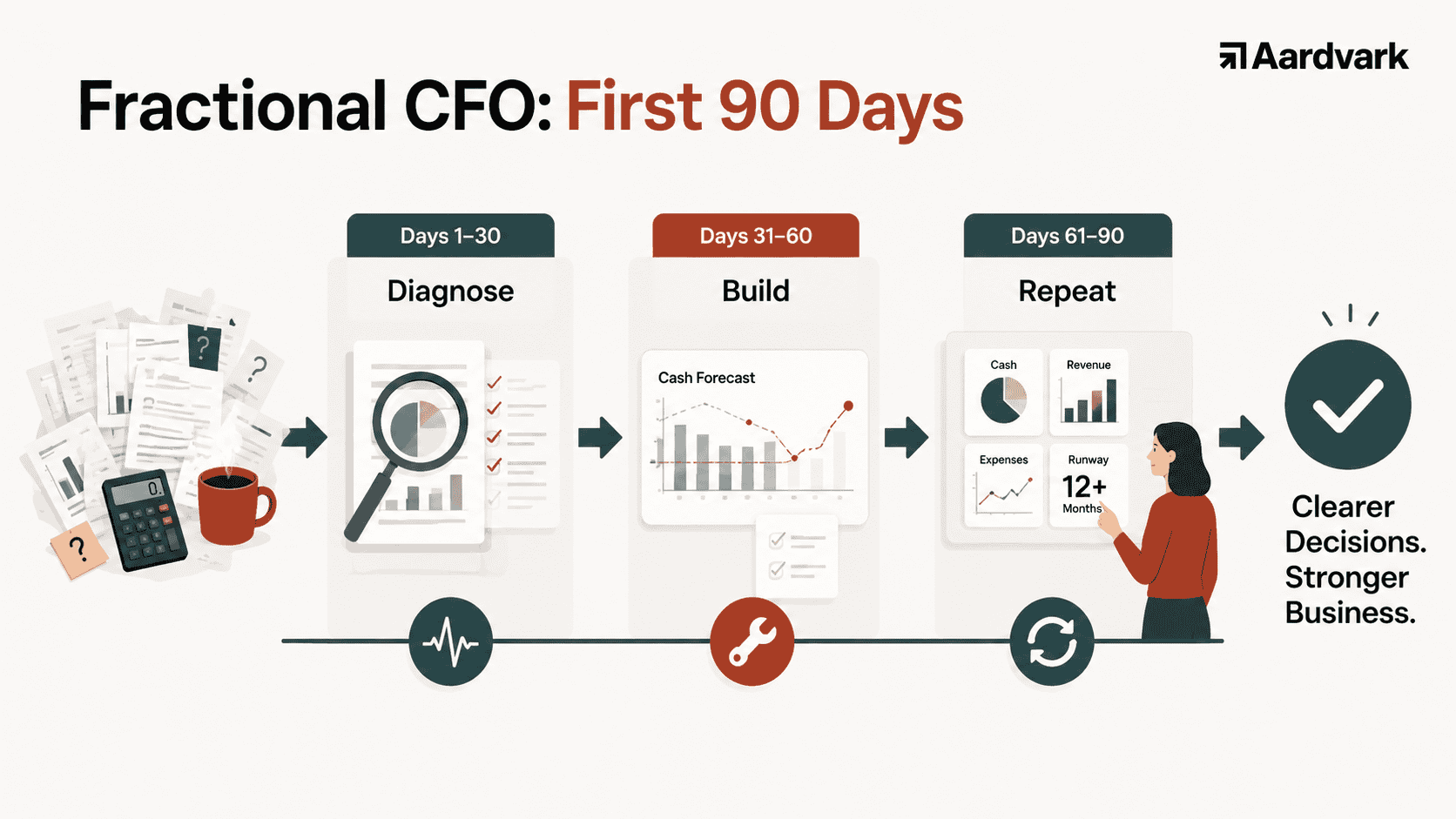
A useful engagement changes how financial decisions get made. The first 90 days typically move from diagnosis to financial modeling to implementation, with the CFO learning how the business actually makes money before recommending changes.
If you’re trying to understand how fractional CFO engagement works, this guide walks through the process from the first information request through the end of a three-month sprint. It also explains what the business owner needs to provide, what should be delivered, and what progress should look like along the way.
Key takeaways
- A fractional CFO engagement should begin with a specific business problem, not a vague request to “improve the finances.”
- The first month is primarily diagnostic. The CFO needs reliable financial data, system access, and operational context before major recommendations are useful.
- Months two and three should move into implementation, testing assumptions, and creating a repeatable financial management rhythm.
- The best deliverables connect financial statements to real decisions about pricing, hiring, cash, margins, debt, and growth.
- A 90-day sprint should leave the owner with better financial visibility and a clearer decision process, even if the CFO relationship continues afterward.
What happens before the 90-day sprint begins
The fractional CFO process starts before the formal onboarding meeting.
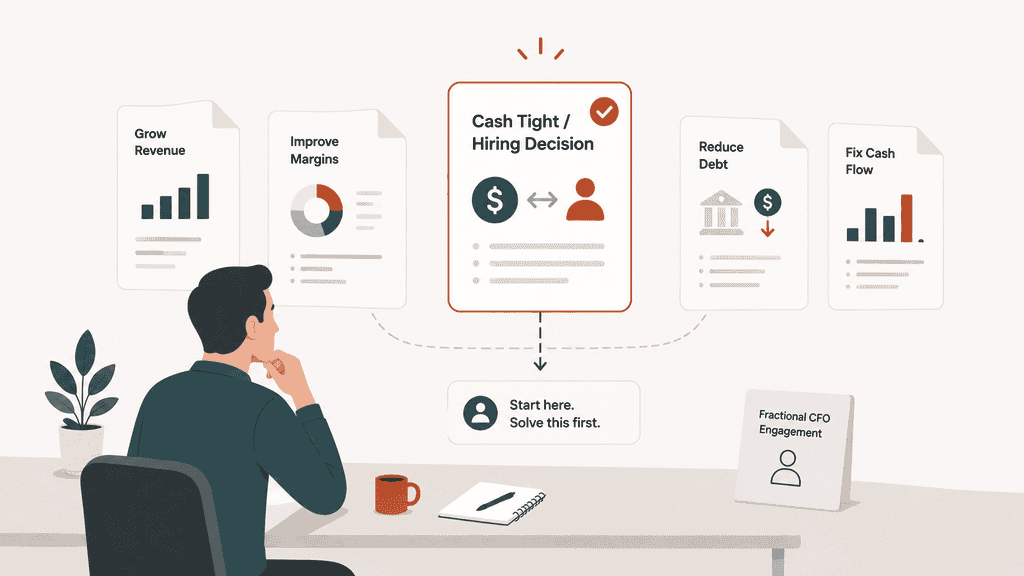
A good provider should first clarify why the business is looking for CFO-level support. “We need better financial strategy” is too broad. The useful question is what decision or financial problem has become difficult enough to require senior financial attention.
That issue might be unpredictable cash flow, shrinking margins despite higher revenue, uncertainty about hiring, debt pressure, poor reporting, or plans for expansion. Businesses dealing with several disconnected finance functions may also need someone to create a unifying financial strategy across the bookkeeper, accountant, owner, and operating team.
Start with one primary financial problem
A 90-day engagement works better when the first sprint has an identifiable target.
Consider two companies with the same annual revenue.
Company A says, “We need a CFO because we’re growing.”
Company B says, “Revenue has increased, but cash is tighter each month. We plan to hire three people next quarter and don’t know whether cash flow can support it.”
Company B has given the CFO something actionable. The CFO can examine receivable timing, gross margins, payroll obligations, working capital, and projected hiring costs. Those variables can then be modeled against the growth plan.
That does not mean other problems are ignored. It means the engagement has a starting point.
Agree on access before work begins
The CFO will usually need more than a profit and loss statement.
Depending on the business, onboarding may require access to:
- The accounting platform, such as QuickBooks Online.
- Recent profit and loss statements, balance sheets, and cash flow statements.
- Bank and credit account information.
- Accounts receivable and accounts payable aging.
- Payroll and compensation data.
- Sales pipeline or customer revenue data.
- Existing budgets, forecasts, debt schedules, and operational reports.
This access matters because financial statements cannot explain every operational cause on their own. A declining gross margin could come from vendor pricing, labor overruns, discounting, an unprofitable service line, or several factors at once.
The IRS also notes that accurate business records are necessary for preparing reliable financial statements and monitoring how a company is performing. Its small business recordkeeping guidance explains why transaction records and supporting documents need to be complete and organized.
The CFO cannot build a trustworthy forward-looking model on unreliable historical data. If the books contain material problems, part of the onboarding period may involve coordinating with the bookkeeper, accountant, or CPA to clean them up.
How fractional CFO engagement works across the first 90 days
A useful cfo onboarding timeline is less about completing a fixed list of tasks and more about moving through three distinct stages: understand, act, and establish a repeatable management process.
Aardvark’s fractional CFO services follow a three-month sprint in which month one is used to understand the company’s current financial state and months two and three shift toward execution.

A practical 90-day framework looks like this:
| Period | Primary focus | Typical work | What the owner should gain |
| Days 1 to 30 | Diagnose | Data access, financial review, operating questions, KPI review, cash analysis | A clear picture of what is happening and why |
| Days 31 to 60 | Build and act | Forecasting, scenario models, reporting improvements, priority actions | Financial tools tied to real decisions |
| Days 61 to 90 | Test and establish | Measure early results, revise assumptions, build recurring review cadence | A repeatable financial management process |
Days 1 to 30: understand what is actually happening
The first month should be heavy on questions.
The CFO needs to understand the business model before interpreting the numbers. That includes how revenue is generated, when cash is collected, what it costs to deliver the product or service, which expenses scale with sales, and which costs stay relatively fixed.
Financial statements are examined together rather than independently.
The balance sheet helps reveal debt, working capital, accumulated liabilities, receivables, and liquidity. The profit and loss statement shows the economics of operations over a period. Cash movement then helps explain whether accounting profit is turning into spendable cash.
The U.S. Small Business Administration describes the balance sheet as a foundation for managing business finances, particularly when assessing assets, liabilities, equity, costs, and future cash requirements.
The CFO will also compare the accounting story with what the owner and operating team say is happening.
Suppose a marketing agency believes its biggest problem is excessive overhead. Analysis might instead show that overhead is stable while project labor regularly exceeds what was assumed in pricing.
The original concern was “we spend too much.” The actual problem may be “we are underpricing the work relative to delivery cost.”
That distinction changes the action plan.
Days 31 to 60: turn the diagnosis into financial tools
By the second month, the engagement should become noticeably more operational.
This is when the CFO begins building or refining the models needed to make decisions. The exact work depends on the problem identified during month one.
For a cash-constrained business, the priority may be cash flow forecasting and working capital. For a company preparing to expand, the work might center on hiring scenarios, capacity, expected margins, and the amount of cash required to finance growth.
This phase might include:
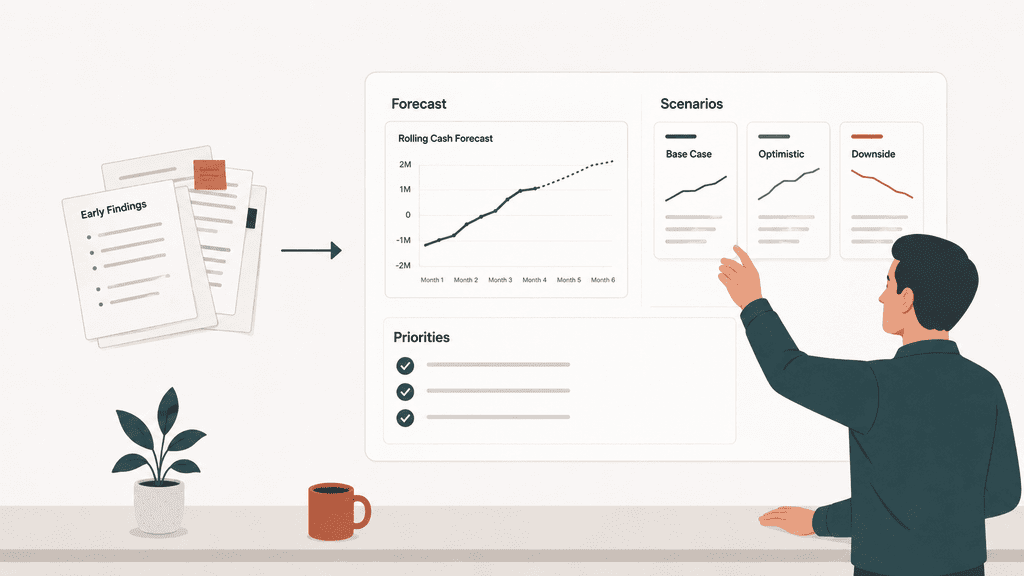
- Building a rolling cash forecast based on actual collection and payment timing.
- Creating a budget or reforecast tied to operational drivers.
- Identifying a short list of key performance indicators rather than reporting dozens of metrics.
- Separating profitable and weak products, locations, customers, or service lines.
- Modeling major decisions before money is committed.
- Creating a management reporting package that leadership can use repeatedly.
The value comes from turning financial information into choices.
If the CFO determines that a company will fall below its preferred cash reserve in eight weeks under its current hiring plan, the conversation changes. Leadership can delay a hire, improve collections, revise spending, secure financing earlier, or adjust the growth plan before cash becomes an emergency.
Days 61 to 90: make the new process repeatable
Month three should not simply produce a larger spreadsheet.
The goal is to establish a financial operating rhythm that leadership can continue using. Forecasts are updated with actual results. Earlier assumptions are tested. KPIs are reviewed. The CFO begins separating temporary anomalies from persistent business issues.
This is also where early actions have had enough time to produce information.
A pricing change may not prove its full financial impact within 90 days, but the business can see whether new proposals are going out at the revised rates. A collections initiative may begin reducing overdue receivables. A new reporting process may finally show margin by department or service line.
The CFO can then refine the model instead of treating the first forecast as permanent.
This matters because forecasts are not predictions. They are decision tools built from assumptions that should change when the business changes.
What the CFO is actually building during the sprint
The outputs of a fractional CFO engagement should depend on the company’s problem. Still, several pieces of financial infrastructure commonly emerge during the first 90 days.
A financial baseline everyone trusts
Leadership needs one agreed view of financial reality.
That sounds obvious, but growing businesses often have conflicting numbers across accounting software, CRM reports, spreadsheets, sales dashboards, and owner-created calculations.
The first job is not creating another dashboard. It is determining which numbers are reliable, how they are calculated, and which system owns them.
For example, “revenue” in a CRM may mean signed contracts while accounting revenue reflects a different recognition point. Neither number is automatically wrong. They simply answer different questions.
The CFO needs to define those differences so leadership stops debating the numbers and starts using them.
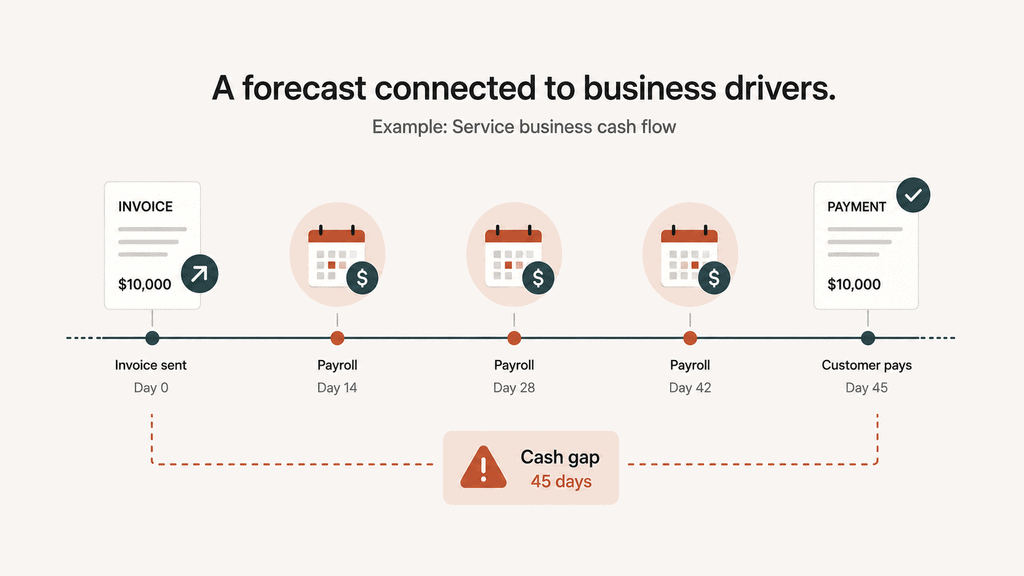
A forecast connected to business drivers
A good forecast should be traceable to real activity.
For a professional services firm, that might mean booked revenue, sales pipeline, headcount, salaries, contractor costs, utilization, payment terms, and expected collections.
For a product company, the important drivers may include sales volume, unit margin, inventory purchases, fulfillment costs, receivable timing, and supplier payment terms.
The model should allow the team to change meaningful assumptions.
For example, imagine a service company planning to add two employees because revenue is growing. A basic annual budget may show enough profit to support the hires. A cash forecast could reveal a different picture because customers pay 45 days after invoicing while payroll occurs every two weeks. The business may still hire, but it can change the timing or arrange working capital before the cash gap appears.
That is a much better decision than simply asking, “Do we have enough money in the bank today?”
A limited set of operational KPIs
Not every measurable number deserves executive attention.
The CFO should identify metrics that explain what drives the financial outcome the business cares about.
Those might include gross margin by service line, labor as a percentage of revenue, accounts receivable days, recurring revenue, revenue concentration, utilization, inventory turnover, or revenue per employee.
The metric depends on the business.
A company trying to plan for growth might need to track whether staffing capacity and cash are keeping pace with projected sales. A company struggling with profitability may care more about gross margin and delivery cost.
A decision framework
One overlooked output of CFO work is a better way to make decisions.
Instead of answering “Can we hire?” with yes or no, the CFO may structure the discussion around:
- The monthly fully loaded cost of the position.
- The revenue or capacity assumption behind the hire.
- The expected cash impact.
- The downside scenario if sales arrive later than expected.
- The trigger that would cause the company to delay or proceed.
The result is not certainty. It is a more disciplined decision made with visible assumptions.
How to make the fractional CFO process work inside your team
A fractional CFO can analyze the company, but the business still has to participate.
The fastest engagements are usually those where financial information is accessible, decision makers respond quickly, and the CFO can speak directly with the people who understand how operations work.

Use this onboarding checklist
Before the first working session, make sure your team can answer these questions:
- What is the primary financial problem we want to address during the first 90 days?
- Who owns bookkeeping, accounting, payroll, billing, and tax work today?
- Can the CFO access the accounting and reporting systems needed for analysis?
- Are the books reasonably current, and do we know where material data issues exist?
- Which major decisions are coming within the next three to six months?
- Who needs to participate when financial recommendations affect operations?
- What measurable change would make the engagement worthwhile?
These questions prevent onboarding from becoming a month-long document hunt.
Keep the existing finance team involved
A fractional CFO generally should not replace a capable bookkeeper or tax professional simply because a CFO engagement begins.
The jobs are different.
A bookkeeper may own transaction recording and reconciliations. A CPA may advise on tax and compliance matters. The CFO uses reliable financial information to guide planning, analysis, capital decisions, forecasting, and business performance.
That makes coordination important.
If the CFO notices that accounts receivable aging is unreliable, the answer is not necessarily to take over bookkeeping. The better solution may be to define the reporting problem, work with the accounting team to correct it, and then use the improved information in the forecast.
Give the CFO operational context, not just spreadsheets
Finance problems often begin outside the finance department.
A margin problem might involve sales discounts. A cash problem could start with contract terms. A forecasting error may come from unrealistic pipeline assumptions. Excess overtime may reveal a staffing or scheduling issue rather than a payroll issue.
This is why fractional CFOs often need conversations with sales, operations, and leadership.
Accounting software can show that labor cost increased. It cannot always explain what operational decision caused the increase.
QuickBooks, for example, provides financial reports and customizable reporting tools, but reports still need interpretation. Intuit’s QuickBooks Online reporting documentation describes the range of financial and management reporting available inside the platform.
The CFO’s job is to connect that information to what people are doing inside the business.
What success should look like by day 90
A first 90-day sprint should not be judged solely by whether profit increased.
Some financial improvements take longer than three months to fully cycle through a company. Hiring changes, pricing decisions, cost restructuring, customer mix, and growth investments can take several reporting periods to show their full effect.
A better question is whether the business is operating with more financial control than it was on day one.
By the end of the sprint, leadership should usually be able to answer questions such as:
Where is our cash going?
The company should understand major inflows, outflows, working capital pressure, and upcoming cash requirements.
Which parts of the business produce acceptable economics?
Management should have greater visibility into margins, costs, and the financial drivers behind performance.
What happens if our assumptions change?
Leadership should have a model that can test scenarios instead of rebuilding the financial plan from scratch every time circumstances change.
Which financial metrics should we review regularly?
The team should have a smaller, more useful reporting set tied to business decisions.
What are our next priorities?
A strong CFO engagement should leave the company with an ordered list of financial actions rather than a collection of unrelated recommendations.
The best outcome is not dependence on the CFO for every financial question. It is a stronger management system in which leadership has better information and knows when senior financial judgment is needed.
After the initial sprint, some businesses continue with ongoing CFO support. The cadence may include monthly financial analysis, forecast updates, operational KPI reviews, balance sheet oversight, growth monitoring, and collaboration on significant decisions.
Others may reduce the level of support once a specific problem has been solved. The appropriate arrangement depends on how quickly the business changes and how much senior financial decision-making it requires.
Because this topic involves business finance, the framework above should be treated as general educational information rather than individualized accounting, tax, legal, or investment advice. Important decisions should be reviewed with professionals familiar with your company and circumstances.
Make the first 90 days about better decisions
A fractional CFO sprint works when it moves beyond reporting what already happened.
The first month establishes financial reality. The next two months turn that understanding into forecasts, priorities, operating changes, and a repeatable management rhythm. By day 90, the most useful result is a business that can see financial problems earlier and make important decisions with clearer assumptions.
That is the standard worth using when you evaluate any fractional CFO engagement.
FAQs
How long does fractional CFO onboarding usually take?
The intensive onboarding period often occupies much of the first month because the CFO needs access to financial systems, historical reporting, and operational context. A focused team with current books and organized records can move into analysis faster than a business that first needs significant accounting cleanup.
What information does a fractional CFO need during onboarding?
Expect requests for financial statements, accounting-system access, receivables and payables data, bank information, budgets, forecasts, payroll information, and relevant operational reports. The exact list depends on the problem the engagement is designed to solve.
What happens in the first meeting with a fractional CFO?
The first meeting should clarify the company’s priorities, current financial concerns, upcoming decisions, available data, and existing finance roles. It should also establish communication expectations, system access, and what success should look like during the initial engagement.
Should a fractional CFO create a 90-day plan?
Usually, yes, although it should not be rigid. A useful plan identifies the initial problem, information required, major analysis, expected deliverables, and decision points while leaving room for the diagnosis to uncover a more important issue.
When should a business expect results from a fractional CFO?
Useful insight can appear within the first month, but implementation normally takes longer. By day 90, you should expect greater financial visibility, working models or reporting systems, and concrete actions underway rather than expecting every financial outcome to be fully realized.
Does a fractional CFO replace a CPA or bookkeeper?
Usually not. Bookkeepers, accountants, CPAs, controllers, and CFOs handle different parts of the finance function, and a fractional CFO commonly works with the existing team rather than replacing it.
What happens after the first 90 days?
The business and CFO should review what changed, what remains unresolved, and which decisions require ongoing financial leadership. The relationship may continue through monthly reporting, forecasting, KPI reviews, scenario planning, and support for major strategic decisions.