


A creative agency can have a full pipeline, a busy team, and rising revenue while still leaving its owner unsure about cash, hiring, or profitability. Project timing, contractor costs, scope changes, retainers, and uneven collections make agency finances harder to read than a monthly profit and loss statement suggests.
A fractional CFO for creative agencies adds senior financial leadership without requiring a full-time executive hire. The value is not simply better reporting. It is having someone connect the numbers to decisions about pricing, capacity, clients, hiring, and growth.
Key takeaways
- Agency revenue can look healthy while project margins, utilization, or cash collection tell a different story.
- A fractional CFO works above routine bookkeeping, turning financial information into decisions about pricing, hiring, capacity, and growth.
- Useful agency reporting should separate project economics from overhead instead of relying only on company-wide profit.
- Forecasting becomes more useful when it includes contracted work, probable pipeline, staffing commitments, payment timing, and owner decisions.
- The right time to seek CFO-level support is usually when financial uncertainty starts limiting important decisions, not simply when revenue reaches a particular number.
Why creative agencies need a different financial approach
Creative agencies sell expertise and capacity rather than physical inventory. That sounds financially simple until several client projects overlap, freelancers are added quickly, retainers renew at different dates, and a major invoice remains unpaid for another 30 days.
A standard income statement can tell you whether the company made money during a period. It does not automatically tell you which account consumed more senior labor than expected, whether the next hire is affordable, or how a delayed client payment affects payroll six weeks from now.
That distinction is where financial strategy for agency owners becomes useful.
Revenue is not the same as economic capacity
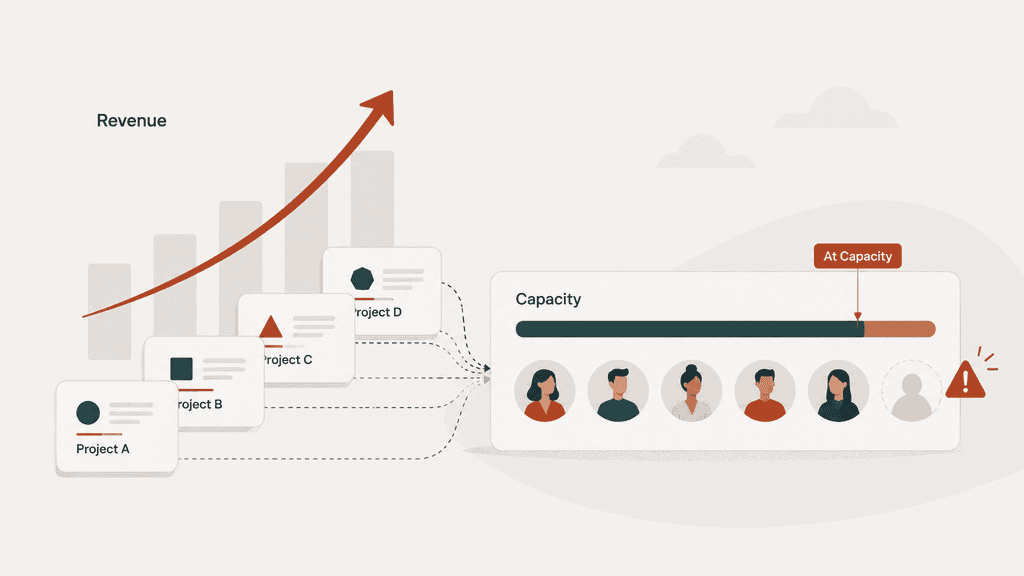
Consider an agency that signs $150,000 of new work during a strong quarter. On paper, sales look excellent. The agency may still have a financial problem if delivering that work requires excessive freelance support, overtime, or additional hires that were not included in the proposal.
Creative businesses have a limited amount of productive capacity. Every designer, strategist, writer, developer, or account manager has only so many workable hours. If a project consumes more of that capacity than expected, the agency effectively gives away resources that could have been sold elsewhere.
This makes gross margin analysis more useful when it goes below the company level. Owners need to know the economics of individual services, client types, or projects. A deeper review of profitability problems despite revenue growth can reveal whether higher sales are actually producing stronger financial performance.
Project profitability can disappear quietly
Suppose a branding engagement sells for $40,000.
The original delivery plan includes:
- 220 internal labor hours.
- $5,000 in freelance support.
- $2,000 in outside production expenses.
- Two rounds of client revisions.
Then the client requests additional concepts, revisions extend into a fourth round, and senior leadership spends another 30 hours managing the relationship. The invoice has not changed, but the economics have.
If the agency only reviews total monthly revenue and payroll, that margin erosion may remain hidden.
A useful CFO-level view asks different questions:
- What did the agency expect the project to cost?
- What is it actually costing?
- Which role or phase is driving the variance?
- Is the issue pricing, scope control, staffing, estimation, or execution?
- Should the agency change this project’s process or its pricing model for future work?
Those questions turn accounting data into operating decisions.
Cash timing creates another layer of risk
A profitable agency can still experience a cash shortage.
One client may pay a large deposit in January while most delivery expenses hit in February and March. Another may be invoiced after a milestone but take 45 days to pay. Meanwhile, payroll, software subscriptions, rent, taxes, and contractor bills continue on schedule.
That is why profit and cash should be reviewed separately.
The U.S. Small Business Administration notes that useful financial management includes the balance sheet and cash flow projections, not only income and expenses. Its guidance also recommends using financial projections when planning future business needs. SBA guidance on managing business finances provides a useful foundation for this distinction.
What a fractional CFO for creative agencies actually does
A bookkeeper records what happened. A controller typically strengthens accounting processes, reporting, and financial controls. A CFO works further forward, helping leadership decide what should happen next and what the financial consequences could be.
For a creative business, the work should be tied closely to the agency’s delivery model.
| Area | Basic financial question | CFO-level agency question |
| Cash | How much money is in the bank? | What will cash look like 8 to 13 weeks from now under different collection and hiring assumptions? |
| Revenue | How much did we bill? | Which revenue is recurring, contracted, probable, or dependent on new sales? |
| Profitability | Did the company make a profit? | Which services, projects, and client relationships produce healthy contribution margins? |
| Staffing | What does payroll cost? | When does forecasted demand justify another employee instead of freelancers or overtime? |
| Pricing | What do we charge? | Does pricing cover the true delivery cost, overhead burden, risk, and desired margin? |
| Growth | How fast are we growing? | Is growth generating cash and durable profit, or merely increasing workload? |
A fractional CFO should not replace accurate accounting. They depend on it. Their job is to make financial information useful for leadership.
Build a forecast that reflects how the agency sells
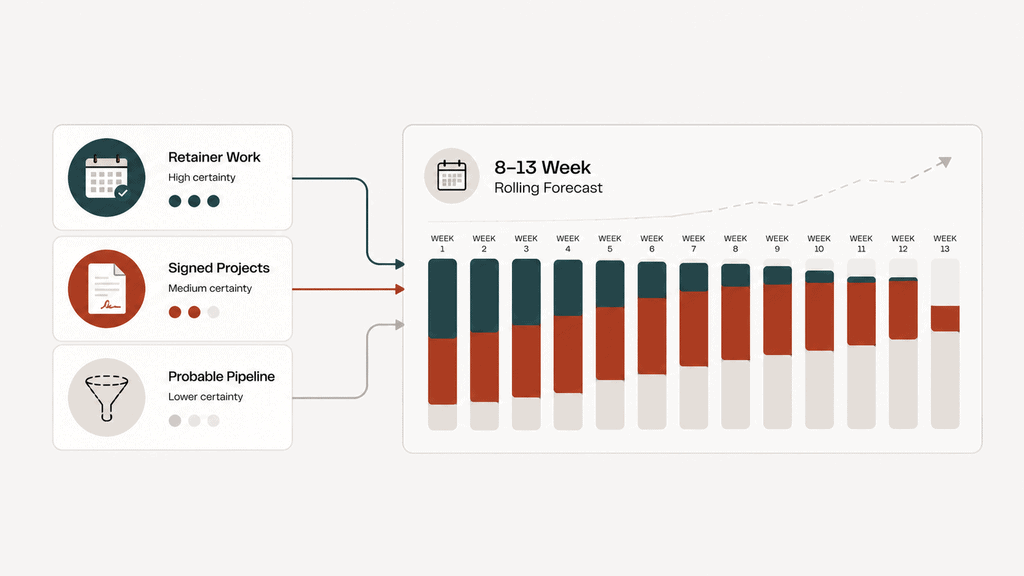
Creative agencies rarely have one perfectly predictable revenue stream. The forecast may include monthly retainers, fixed-fee projects, recurring production work, and potential projects still moving through the sales pipeline.
Treating all of these as equally certain produces a misleading forecast.

A practical model can separate revenue into categories such as:
- Signed and scheduled work.
- Retainer revenue under active contracts.
- Highly probable opportunities with defined timing.
- Earlier pipeline that should not yet support fixed-cost commitments.
- Potential expansion work from existing accounts.
The same model should map expected collection dates rather than assuming an invoice becomes cash immediately.
A dedicated cash flow forecasting process can then connect sales timing, invoices, payroll, contractor commitments, taxes, and other obligations.
The SBA likewise recommends that established businesses use income statements, balance sheets, and cash flow statements in financial planning and make near-term projections more detailed. Its business planning guidance specifically discusses monthly or quarterly financial projections for the first forecast year.
Measure project and client economics
Agency owners often know which clients feel difficult. Financial analysis helps determine whether that feeling has an economic basis.
A useful project review might compare:
- Contract value.
- Planned direct labor.
- Actual direct labor.
- Freelancer or subcontractor expense.
- Other direct project costs.
- Gross profit dollars.
- Gross margin percentage.
- Write-offs, discounts, or unbilled work.
The purpose is not to punish a team for spending an extra hour on a client. It is to identify patterns.
If strategy projects repeatedly outperform production work, that can influence service mix. If a particular client regularly exceeds scope, the agency may need a different contract structure. If smaller projects require almost as much account management as larger ones, minimum engagement sizes may need review.
Make hiring a financial decision, not a stress response
Hiring often happens after the team feels overloaded. By then, owners may be deciding under pressure.
A CFO for a marketing agency can model the decision earlier.
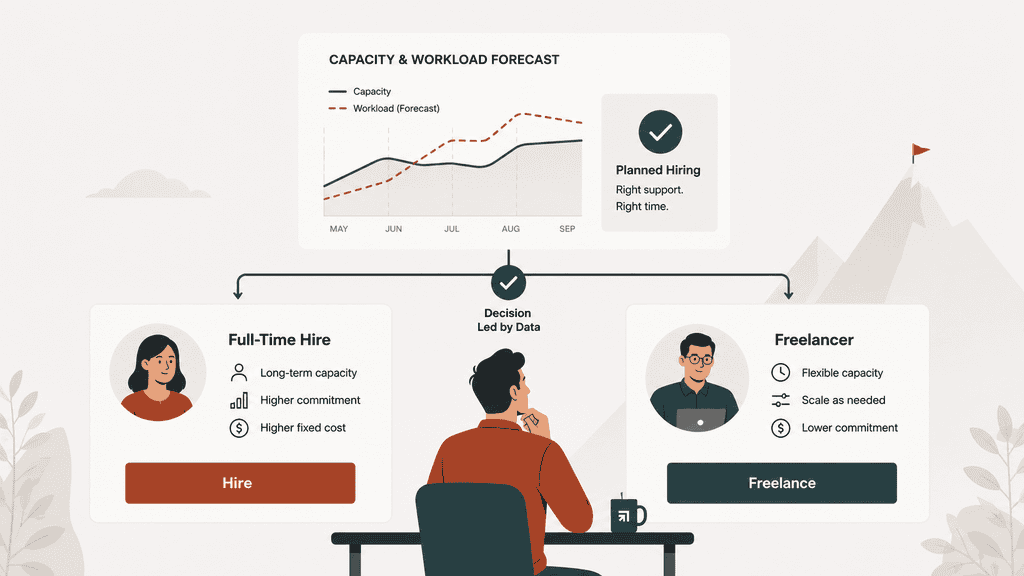
For example, assume the leadership team is considering another full-time designer. The analysis should not stop at salary. It can include employer taxes and benefits, software, equipment, recruiting costs, expected productive capacity, the amount of signed work already available, and the realistic time needed to reach normal utilization.
Then compare that scenario with continuing to use freelancers for another quarter.
The answer may still be to hire. The difference is that the decision now has defined assumptions and downside scenarios.
Improve pricing with actual delivery data
Pricing problems are rarely solved by applying a blanket percentage increase.
An agency may discover that one service is underpriced while another has excellent margins. Retainer work may be profitable at contracted scope but weak once untracked requests accumulate. A large client may generate significant revenue while requiring enough senior attention to make its economics less attractive than several smaller accounts.
A fractional CFO can help connect pricing to actual delivery costs and capacity.
That does not mean finance should determine what creative work is “worth.” Market positioning, expertise, demand, and client value still matter. Financial analysis simply establishes the economic floor and shows what different pricing choices mean for the business.
A practical financial operating system for agency owners
Better finance does not require dozens of dashboards. It requires a repeatable set of numbers that answer the agency’s most important questions.
For many firms, the following workflow is more useful than producing additional reports without changing how decisions get made.
Step 1: Make the accounting reliable
Before building forecasts, confirm that revenue, expenses, payroll, contractor costs, receivables, liabilities, and balance sheet accounts are reasonably current and categorized consistently.
If the agency’s bookkeeper, CPA, and leadership team each work from different numbers, strategic analysis will be unreliable. This is a common reason growing businesses develop a fragmented financial team with plenty of financial activity but no single strategic view.
Tax accounting and management reporting also should not be confused. The IRS explains that cash and accrual accounting recognize income and expenses at different times, and the appropriate tax treatment depends on the business and applicable rules. IRS Publication 538 explains these accounting methods in more detail.
Step 2: Establish a small set of agency KPIs
The exact metrics depend on the business model, but an agency might monitor:
- Revenue by service line or client type.
- Gross margin by project or service.
- Direct labor against project budgets.
- Accounts receivable and overdue invoices.
- Cash runway or forward cash position.
- Recurring versus project-based revenue.
- Forecast variance between expected and actual performance.
Do not add a metric simply because another agency tracks it. A KPI should change a decision.
For example, utilization may matter greatly for a time-based production model but less for a consultancy that prices primarily around intellectual property or outcome value.
Step 3: Build an 8 to 13-week cash view
A short-term cash model should begin with the current bank position and map expected inflows and outflows by week.
Include actual expected payment dates where possible, not merely invoice due dates.
Then add payroll, freelancer payments, taxes, software, debt service, rent, planned owner distributions, and unusual expenses. Update the forecast regularly as information changes.
The point is not perfect prediction. The point is seeing pressure early enough to respond.
Step 4: Create a rolling operating forecast
The cash forecast answers, “Can we meet our obligations?”
The operating forecast answers, “Where is the business headed?”
Model the coming months using realistic assumptions for signed work, pipeline conversion, delivery capacity, direct costs, and overhead. Compare actual results with the forecast every month and investigate meaningful differences.
If an agency forecasted a 45% project margin but repeatedly lands near 30%, the variance deserves explanation. Perhaps project estimates are wrong. Perhaps client revisions are expanding. Perhaps senior staff are doing production work that was budgeted for junior roles.
Variance is information.
Step 5: Run decisions through scenarios
Once the model works, use it before committing money.
Instead of asking, “Can we afford another account director?” model three cases:
- Hire next month.
- Hire after another large contract closes.
- Delay the hire and use contract support temporarily.
For each option, look at cash requirements, capacity, profit, and the consequences if sales arrive later than expected.
This is one of the clearest differences between reporting and financial leadership. Reporting explains the past. Scenario planning helps leadership choose among possible futures.
Step 6: Review the numbers on a fixed cadence
A useful monthly financial meeting should produce decisions, not merely observations.
A simple agenda could include:
- Review last month’s results against forecast.
- Identify major margin or expense variances.
- Review cash for the coming 8 to 13 weeks.
- Update sales and delivery assumptions.
- Review outstanding strategic decisions.
- Assign actions and revise the forecast.
The owner should leave knowing what changed and what the team will do because of it.
A practical agency scenario
Consider a hypothetical 18-person design and marketing agency.
Revenue has grown, but cash feels increasingly tight. Leadership believes the solution is more sales.
A closer review finds something different. Two large fixed-fee accounts regularly exceed their original labor budgets. The agency has also added freelancers to manage peaks in workload, but those costs were not consistently included when management reviewed project margins. Meanwhile, several large invoices are collected later than the forecast assumes.
The immediate answer may not be “sell more.”
The better sequence could be to improve scope management on the two accounts, include contractor costs in project reporting, revise future pricing, and change the cash forecast to reflect realistic collections. Once those changes are visible, leadership can decide whether additional sales or hiring would strengthen the business rather than increase the existing pressure.
That is the practical purpose of CFO-level analysis.
When fractional CFO support makes sense
There is no universal revenue threshold at which every creative agency suddenly needs a CFO. Complexity matters as much as size.
An owner running a focused studio with predictable retainers and strong financial controls may need less support than a similarly sized agency juggling multiple service lines, contractors, uneven project schedules, and rapid hiring.
Signs the finance function has fallen behind the agency
Fractional CFO support may be worth considering when several of these situations are familiar:
- You regularly ask whether the agency can afford a hire but cannot answer confidently.
- Revenue is increasing while cash or owner distributions are becoming less predictable.
- You cannot see reliable profitability by client, project, or service.
- Your annual budget becomes irrelevant within a few months.
- Leadership makes pricing decisions without knowing the actual cost of delivery.
- Your bookkeeper and CPA are doing their jobs, but nobody owns forward-looking financial strategy.
- Large decisions depend mainly on the current bank balance.
A quick financial fitness check can also help identify whether gaps are concentrated around reporting, costs, cash flow, or decision-making.
Fractional CFO vs bookkeeper, controller, and full-time CFO
| Role | Primary focus | Usually the right fit when |
| Bookkeeper | Transaction recording and account maintenance | You need accurate books and routine financial administration. |
| CPA or tax professional | Tax preparation, compliance, and tax advice | You need tax filings, tax planning, or entity-specific tax guidance. |
| Controller | Accounting operations, close process, controls, and reporting | Financial activity has become complex enough to require stronger accounting management. |
| Fractional CFO | Forecasting, financial strategy, performance analysis, and leadership decisions | The business needs senior finance thinking but not necessarily a full-time executive. |
| Full-time CFO | Continuous executive financial leadership | Financial complexity and leadership demands justify a dedicated internal executive. |
These roles can work together. Hiring a CFO does not solve weak bookkeeping, and good bookkeeping does not replace strategic financial planning.
Questions to ask before hiring a fractional CFO
Industry familiarity matters because agency economics differ from those of inventory businesses, SaaS companies, or manufacturers.
Ask prospective CFOs how they would approach real agency decisions, not just which reports they provide.
Useful questions include:
- How do you calculate project and service-line profitability for an agency?
- How would you incorporate signed work and pipeline into a forecast?
- How do you help decide between hiring employees and using contractors?
- What information do you need from time-tracking or project management systems?
- How do you work with an existing bookkeeper and CPA?
- What happens during the first 30, 60, and 90 days?
- Which decisions should improve once the engagement is working?
Strong answers should describe a process. Be cautious if the conversation stays at the level of dashboards, generic budgeting, or broad promises about growth.
Because CFO work touches tax, accounting, and other financial decisions, owners should also distinguish strategic business guidance from professional tax or legal advice. Federal tax requirements vary by entity and circumstances. The IRS notes, for example, that many businesses may need to make estimated tax payments during the year. IRS business tax guidance provides general federal information, while a qualified tax professional should address business-specific questions.
This article is general educational information rather than individualized accounting, tax, legal, or investment advice. Financial topics warrant careful sourcing and appropriate professional review when decisions have material consequences.

Build a finance function that matches the agency
Creative agencies do not need finance for finance’s sake. They need enough financial visibility to price work intelligently, protect delivery margins, plan capacity, manage cash, and make bigger decisions before those decisions become urgent.
The right fractional CFO gives an owner a clearer connection between what the team is doing and what those activities mean financially. When that connection is working, the question changes from “What happened to our money?” to “What should we do next based on what the numbers are telling us?”
FAQs
What does a fractional CFO do for a creative agency?
A fractional CFO helps leadership interpret financial data and use it for decisions about cash flow, forecasting, pricing, margins, staffing, and growth. They typically work alongside the agency’s bookkeeper, accountant, or controller rather than replacing routine accounting functions.
How is a CFO for a marketing agency different from a regular accountant?
An accountant generally concentrates on accurate records, reporting, tax, or compliance work. A CFO for a marketing agency focuses more heavily on forward-looking questions such as whether to hire, which services produce healthy margins, what future cash needs look like, and how growth affects profitability.
Does a small creative agency really need a fractional CFO?
Not every small agency does. Fractional CFO support becomes more relevant when financial complexity or uncertainty starts interfering with meaningful decisions, even if the business is not large enough to justify a full-time finance executive.
Can a fractional CFO help with agency pricing?
Yes, particularly by establishing the economics behind the pricing decision. A CFO can analyze labor, contractor costs, project overruns, overhead, capacity, and target margins so leadership understands what different pricing structures mean financially.
What financial metrics should a creative agency track?
Useful metrics often include cash position, accounts receivable, revenue by service, direct project costs, project or service margins, forecast variance, and recurring versus project revenue. Agencies should choose metrics that influence actual decisions rather than building a large dashboard with numbers nobody uses.
Can a fractional CFO work with our existing bookkeeper and CPA?
Yes. These roles solve different problems. A bookkeeper can maintain accurate transaction records, a CPA can handle tax and compliance matters, and a fractional CFO can use reliable financial information to guide forecasting, planning, and operating decisions.
How should an agency prepare before hiring a fractional CFO?
Make sure the financial records are reasonably current, gather recent income statements and balance sheets, document major client contracts, and identify the decisions that currently feel hardest to make. Project management, time-tracking, payroll, accounts receivable, and sales pipeline data may also be useful because they show how operational activity connects to financial results.