

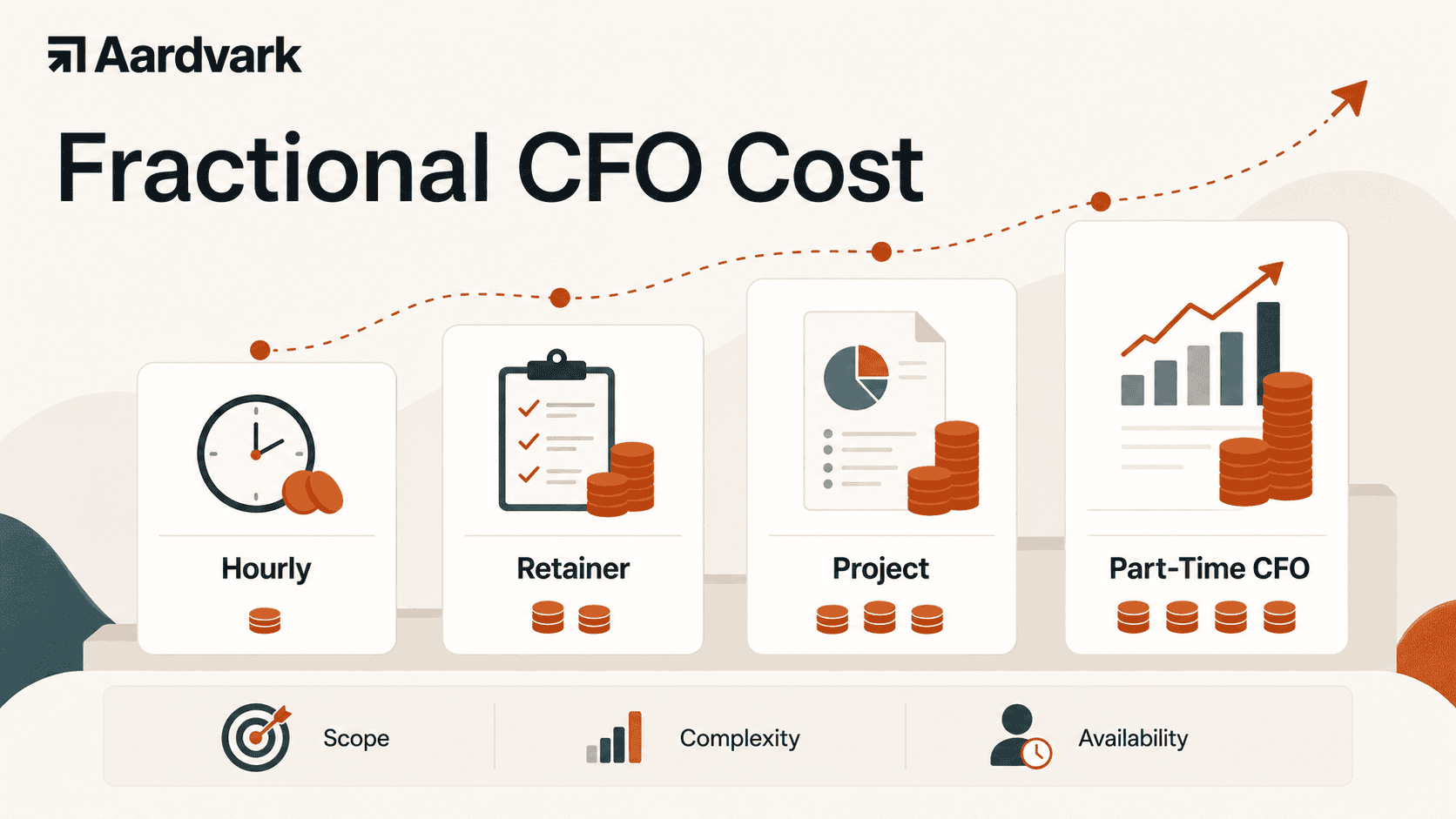
A fractional CFO can cost less than $1,000 per month for limited advisory support or exceed $20,000 per month for complex, hands-on financial leadership. That range is wide because “fractional CFO” can describe anything from a monthly strategy call to someone managing forecasts, lenders, board reporting, pricing decisions, and the wider finance team.
This guide explains what drives fractional CFO cost, how common pricing models work, and how to compare proposals without paying for responsibilities your business does not need.
This article provides general educational information, not accounting, tax, legal, or investment advice. Pricing varies by provider and engagement.
Key takeaways
- Monthly retainers commonly provide better continuity than hourly arrangements when the CFO will own recurring forecasts, reporting, and leadership meetings.
- Fractional CFO pricing depends more on scope, complexity, urgency, and decision responsibility than on company revenue alone.
- A low proposal may exclude essential work such as accounting cleanup, financial modeling, implementation, or team management.
- Businesses should compare deliverables, decision ownership, availability, and expected outcomes rather than hourly rates alone.
- The right engagement should improve the quality and speed of financial decisions, not merely produce more reports.
What does a fractional CFO cost in 2026?
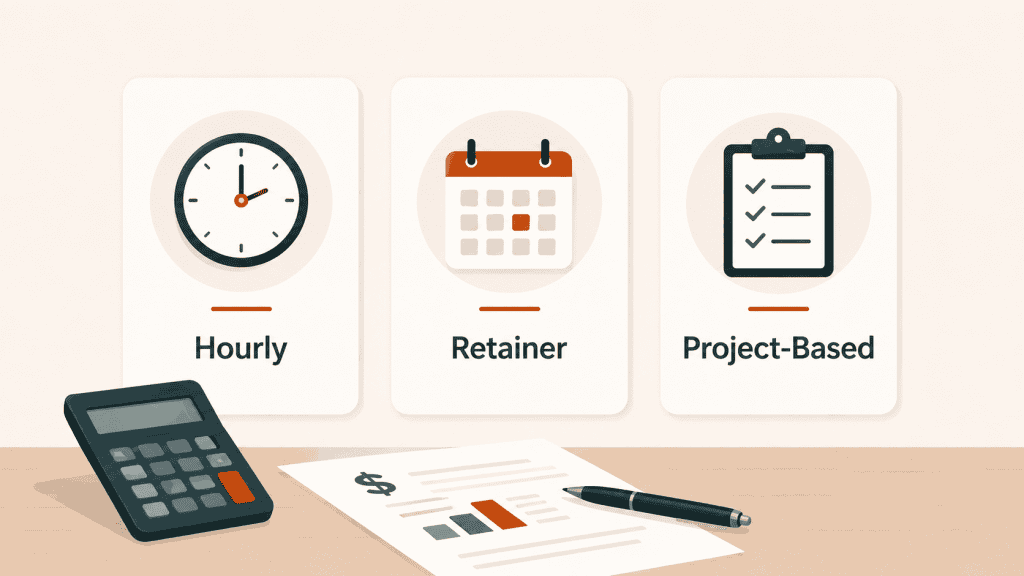
There is no regulated rate card for fractional CFO services. Providers may charge hourly, by project, through a fixed monthly retainer, or according to an agreed level of access and responsibility.
For many established small and midsize businesses, a practical planning range is approximately $2,000 to $12,000 per month. Smaller advisory engagements may fall below that range. Complex engagements involving fundraising, multiple entities, inventory, lender negotiations, or several days of weekly involvement may cost considerably more.

The following ranges are useful for initial budgeting, but they are not universal market prices.
| Engagement level | Illustrative monthly cost | Typical involvement |
| Limited advisory | $750 to $2,500 | Monthly review, owner questions, light forecasting, and selected decision support |
| Core fractional CFO support | $2,500 to $6,000 | Regular forecasting, monthly reporting, KPI analysis, cash planning, and leadership meetings |
| Embedded financial leadership | $6,000 to $12,000 | Weekly involvement, department collaboration, budgeting, scenario planning, and finance-team oversight |
| High-complexity engagement | $12,000 to $25,000+ | Fundraising, mergers and acquisitions, lender management, multi-entity reporting, restructuring, or near-full-time support |
These bands reflect differences in workload, but hours are only part of the equation. Two companies may each receive 20 hours of support per month and pay different amounts because one requires routine forecasting while the other needs board preparation, lender communication, and decisions involving significant financial risk.
Published fractional CFO pricing examples also show why company size alone is a weak pricing tool. One engagement may focus on building basic financial visibility for a small agency, while another may require cash management and strategic processes for a larger manufacturer. The work required to solve the problem matters more than a simple percentage of revenue.
Fractional CFO hourly rate
A fractional CFO hourly rate commonly falls somewhere between $175 and $450 per hour, although specialists may charge more. Rates tend to increase when the CFO has direct experience with institutional fundraising, complex manufacturing, acquisitions, restructuring, audit preparation, or industry-specific financial models.
Hourly pricing is easiest to understand, but it can create the wrong incentive for ongoing leadership. Business owners may delay questions to control the bill. The CFO may also avoid implementation work that falls outside the estimated hours.
Hourly support makes the most sense when:
- You need a second opinion on a defined financial decision.
- The assignment has a limited and predictable scope.
- You are testing the working relationship before committing to a retainer.
- Your existing controller or finance manager can complete the follow-up work.
- You need temporary advice rather than recurring financial leadership.
Suppose a CFO charges $300 per hour and spends 15 hours per month on your business. The direct monthly cost is $4,500. That calculation is useful, but you still need to ask what the 15 hours cover. Meetings, model updates, staff supervision, email access, and preparation time may all be counted differently.
Monthly fractional CFO retainers
Monthly retainers are common because finance work follows a recurring cycle. Cash must be reviewed, books must close, results must be interpreted, and forecasts must be updated as conditions change.
A retainer may include:
- Weekly or biweekly cash reviews
- Monthly financial reporting and commentary
- Rolling forecasts
- Budget updates and variance analysis
- KPI monitoring
- Pricing and margin analysis
- Leadership meetings
- Communication with lenders, accountants, or investors
- Oversight of bookkeepers, controllers, or external providers
A monthly fee gives both sides a predictable rhythm. It also allows the CFO to learn how the business operates instead of treating each request as an isolated task.
Retainers still need boundaries. The agreement should state how many meetings are included, who completes accounting work, how quickly the CFO responds, and whether major projects require a separate fee.
Part-time CFO cost compared with a full-time hire
The part-time CFO cost is usually lower than hiring a permanent executive because the company pays for a portion of the CFO’s capacity rather than a full salary, payroll taxes, benefits, paid leave, recruiting, and onboarding.
The U.S. Bureau of Labor Statistics reported a mean annual wage of $269,630 for chief executives in its May 2025 occupational wage data. That figure covers chief executives broadly, not CFOs specifically, and does not include the full cost of benefits or other employment expenses. It still provides useful context for the level of compensation associated with senior executive roles. See the BLS occupational wage data for chief executives.
A full-time CFO may be appropriate when the business needs daily leadership, has a large internal finance department, faces constant capital-market demands, or requires an executive who participates in nearly every operational decision.
Fractional support is often a better fit when the need is substantial but not full time. For example, a $5,000 monthly retainer costs $60,000 annually. That does not mean it replaces every function of a full-time CFO. It means the company purchases a defined level of senior expertise without funding a permanent executive position.
What determines fractional CFO pricing?
The fastest way to understand a proposal is to stop asking, “How many hours do we get?” and ask, “What financial responsibilities will this person own?”
A business with clean accounting, one legal entity, predictable revenue, and a capable bookkeeper is easier to support than a business with the same revenue but six entities, unreliable inventory data, unpaid receivables, and a funding deadline.
Scope of responsibility
A limited engagement may require the CFO to review reports and advise the owner. A deeper engagement may make the CFO responsible for producing the forecast, leading monthly reviews, improving systems, directing staff, and following decisions through implementation.
These are very different jobs.
Ask whether the CFO will:
- Diagnose issues or also correct them
- Build the financial model or only review one
- Present recommendations or manage execution
- Supervise the bookkeeping and accounting team
- Communicate with lenders, investors, or board members
- Attend management meetings outside the finance function
- Remain available between scheduled calls
The more decision ownership the CFO accepts, the higher the fee is likely to be.
Quality of the accounting records
Strategic finance depends on reliable underlying data. The Internal Revenue Service notes that good business records support financial statements, track income and expenses, and help owners monitor business progress. Its small-business recordkeeping guidance explains why consistent records matter beyond tax filing.
A CFO cannot produce a dependable forecast from books that are months behind, contain unreconciled accounts, or classify costs inconsistently.
When the records need repair, the provider may:
- Charge a separate cleanup or diagnostic fee.
- Increase the monthly retainer during the initial phase.
- Require the company’s bookkeeper or accountant to complete corrections first.
- Exclude responsibility for forecast accuracy until the records improve.
That is not automatically a warning sign. It is often a sign that the provider understands the limits of the available data.
Business model and operational complexity
Certain business models require more analysis than others.
A professional services firm may need utilization, project margins, backlog, and staffing-capacity forecasts. An eCommerce company may need contribution margin, inventory purchasing, return rates, customer acquisition costs, and payment timing.
A manufacturer may add job costing, work in progress, raw materials, production capacity, and capital equipment. A software company may need recurring revenue metrics, churn, deferred revenue, and scenario planning tied to hiring.
Complexity also increases when a company has:
- Multiple legal entities
- Several locations
- International operations
- Debt covenants
- Irregular revenue
- Seasonal cash cycles
- Complicated ownership arrangements
- Rapid hiring
- Acquisitions or divestitures
A provider with experience in your business model may charge more than a generalist, but relevant experience can reduce the time spent learning basic industry economics.
Meeting cadence and availability
Monthly meetings cost less than weekly participation. A CFO who joins leadership calls, works with department heads, and responds between meetings provides a different service from one who delivers a report once a month.
Clarify whether the quoted price includes:
- Scheduled meetings
- Meeting preparation
- Email or messaging access
- Calls with outside advisors
- Board or investor meetings
- On-site visits
- Travel time and expenses
- Urgent requests
“Access to a CFO” is too vague to compare. The proposal should define how that access works.
Urgency and special projects
Urgent assignments generally cost more because the provider must rearrange other commitments and work with incomplete information.
Examples include:
- A cash shortage expected within six weeks
- A lender requesting updated forecasts
- An investor meeting scheduled next month
- A sudden drop in gross margin
- A failed accounting-system implementation
- An acquisition under consideration
- A delayed financial close
- A board demanding a revised operating plan

Fundraising is another common cost driver. The U.S. Securities and Exchange Commission advises companies to have financial statements ready when preparing to raise capital and to expect the process to consume time and resources. Its capital-raising readiness guidance provides a useful overview.
A CFO supporting a raise may need to rebuild forecasts, define metrics, prepare a data room, respond to diligence questions, and coordinate with legal and tax professionals. That work may be priced separately from routine monthly support.
How fractional CFO pricing models work
The pricing structure affects how the relationship operates. A lower headline rate is not necessarily less expensive once exclusions, overruns, and internal labor are considered.
Hourly billing
Hourly billing gives you flexibility and a direct relationship between time and cost. It works well for assessments, occasional advice, and short assignments.
Its weakness is unpredictability. A seemingly simple question may require several hours of review. Hourly billing can also discourage the regular communication that helps a CFO understand the business.
Before agreeing, ask for:
- The hourly rate for each team member
- Minimum billing increments
- Expected monthly hours
- A spending cap
- Advance approval for overruns
- A list of activities counted as billable time
Fixed monthly retainers
A fixed monthly fee is suited to recurring work with defined responsibilities. It gives the provider room to maintain a forecast, prepare for meetings, and respond to issues without pricing each interaction separately.
The best retainers define outputs, not just availability. Instead of “up to 20 hours,” the agreement might require:
- A 13-week cash forecast updated weekly
- A monthly reporting package by a set date
- A budget-to-actual review
- A monthly leadership meeting
- Quarterly scenario planning
- Defined support for the bookkeeping team
This approach makes it easier to judge whether the service is being delivered.
Project-based fees
Project pricing works when the assignment has a clear endpoint.
Common projects include:
- Building an annual budget
- Creating a financial model
- Preparing a lender package
- Reviewing pricing and margins
- Designing a KPI dashboard
- Assessing finance systems
- Preparing for a capital raise
- Completing financial due diligence
The proposal should specify the assumptions behind the price. A financial model based on clean records is different from one that requires the CFO to reconstruct historical results first.
Project fees may also exclude ongoing updates. A model can become outdated quickly if no one owns it after delivery.
Tiered service packages
Some firms offer packages based on meeting frequency, deliverables, or company complexity. Packages simplify buying, but they can hide important limitations.
Check whether a lower tier excludes:
- Forecast maintenance
- Implementation support
- Bookkeeper supervision
- Department-level analysis
- Board reporting
- Lender communication
- Additional entities
- Custom models
- On-site meetings
A package is useful only when its boundaries match the way your business makes decisions.
Performance-linked or value-based pricing
Some providers connect part of their compensation to defined outcomes. This can create alignment, but it requires careful measurement.
Not every financial benefit can be attributed to one advisor. Revenue, margins, and cash flow may change because of market conditions, owner decisions, sales performance, or operational work completed by other people.
Any performance component should define:
- The baseline
- The measurement period
- The exact formula
- Which outcomes qualify
- Which external effects are excluded
- When payment becomes due
Avoid agreements based on vague promises such as “improved profitability” without a documented calculation.

How to estimate the right budget
A good budget starts with the decisions you need to make, not the title you want to hire.
Step 1: List the financial questions creating risk
Write down the questions the leadership team cannot answer confidently.
Examples include:
- How much can we hire without creating a cash shortage?
- Which services or products generate acceptable margins?
- Can we afford a new location?
- Why is profit increasing while cash declines?
- What happens if revenue misses the plan by 15%?
- How much working capital will growth require?
- Are we ready to approach a lender or investor?
The more frequent and consequential these questions are, the more valuable recurring CFO involvement becomes.
Step 2: Identify what already exists
Inventory your current finance function.
Document:
- Who completes bookkeeping
- How quickly the books close
- Whether accounts are reconciled
- Which reports leadership receives
- Whether a current budget exists
- How cash is forecast
- Who manages tax and compliance work
- Which systems hold financial and operational data
A fractional CFO should not be priced as a replacement for every missing finance role. Bookkeeping, controllership, tax work, payroll, and CFO leadership require different skills.
The guide to what a fractional CFO does can help distinguish forward-looking financial leadership from transaction processing and historical reporting.
Step 3: Define the required deliverables
Turn broad goals into visible outputs.
“Improve financial clarity” is difficult to price. A clearer scope might include:
- Rebuild the chart of accounts
- Establish a monthly close calendar
- Create a rolling 13-week cash forecast
- Build an annual operating model
- Report gross margin by service line
- Hold a monthly management review
- Create hiring thresholds tied to cash and revenue
- Prepare a quarterly lender update
Once the outputs are clear, providers can estimate the real workload.
Step 4: Choose an appropriate cadence
Match the meeting frequency to the speed of the business.
A stable company with predictable revenue may need one formal monthly review and limited support between meetings. A company facing rapid growth, weak cash flow, or active fundraising may need weekly sessions.
The U.S. Small Business Administration’s guidance on managing small-business finances identifies financial statements and cash flow projections as core tools for understanding and planning the business. These tools only stay useful when someone updates and reviews them on a suitable schedule.
Step 5: Compare the total operating cost
Do not compare providers using the monthly fee alone.
Include:
- One-time setup charges
- Accounting cleanup
- Software subscriptions
- Travel expenses
- Project fees
- Additional team members
- Internal staff time
- Contract length
- Termination terms
- Fees for work outside scope
A $3,000 proposal that excludes model building, cleanup, and implementation may cost more than a $5,000 proposal that includes them.
Practical example
Consider a $4 million service company with eight employees and 20 contractors. Revenue is growing, but cash remains unpredictable because clients pay at different times and project margins are unclear.
Provider A offers four advisory hours per month for $1,200. The owner receives useful recommendations but must build the cash forecast, collect project data, and supervise the bookkeeper.
Provider B charges $4,500 per month. The scope includes a weekly cash forecast, project-margin reporting, a monthly close review, contractor-capacity planning, and a monthly leadership meeting.
Provider A has the lower fee. Provider B may offer the lower total cost if the owner would otherwise spend 20 hours each month assembling information and still lack dependable answers.
The correct choice depends on the desired outcome. If the owner only needs occasional guidance, Provider A may be sufficient. If the company needs an operating finance process, Provider B is closer to the actual requirement.
How to decide whether the cost is worthwhile
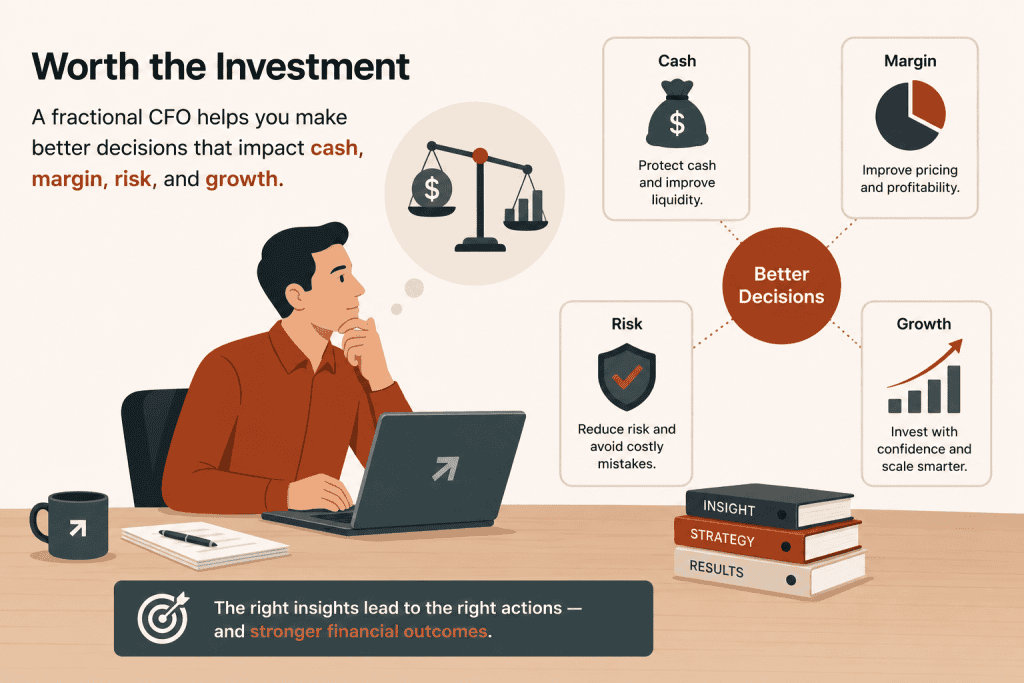
A fractional CFO should not be judged by the number of spreadsheets produced. The service is worthwhile when it improves decisions that materially affect cash, margin, risk, or growth.
Measure decision outcomes
Look for changes such as:
- Faster monthly reporting
- More accurate cash forecasts
- Fewer surprise expenses
- Clearer hiring thresholds
- Better collection discipline
- Improved visibility into margins
- Better lender or investor preparation
- Stronger accountability for budget variances
These outcomes do not guarantee a specific financial return. They show whether the company is operating with better information and control.
Calculate the value of one improved decision
A simple way to test the budget is to identify one decision the CFO could materially improve.
Suppose your company is considering a manager with a $120,000 salary. With payroll taxes, benefits, recruiting, and equipment, the actual first-year commitment will be higher. A forecast showing that the hire should be delayed by four months could preserve significant cash.
The same reasoning applies to pricing, inventory, customer terms, debt, and expansion. A fractional CFO does not need to create dramatic savings every month. Avoiding one poorly timed commitment may justify a substantial portion of the annual fee.
Watch for proposals that are too cheap to be complete
Low pricing is not automatically bad. It becomes a concern when the provider promises broad strategic leadership without enough time or support to understand the business.
Ask how the CFO will:
- Review source data
- Maintain forecasts
- Prepare for meetings
- Coordinate with the accounting team
- Follow up on agreed actions
- Learn the business model
- Handle urgent decisions
If the answer depends on the owner doing most of the analysis, the service may be advisory rather than a true fractional CFO engagement.
Watch for expensive proposals without clear ownership
A high fee is not proof of quality either.
Be cautious when a proposal contains broad terms such as strategic guidance, financial oversight, and executive support without naming deliverables, deadlines, or decision rights.
A useful agreement should answer:
- What will be delivered?
- Who will produce it?
- When will it be ready?
- Who owns implementation?
- How will progress be reviewed?
- What falls outside the fee?
The fractional CFO hiring guide provides additional questions for evaluating experience, scope, systems knowledge, and working style.
Know when you need a different role
A fractional CFO is not always the right first hire.
You may need a bookkeeper when transactions are not being entered or reconciled. You may need a controller when the close is inaccurate, accounting policies are inconsistent, or financial statements require stronger oversight.
You may need a tax professional for tax planning and filings. You may need a full-time CFO when the executive workload is genuinely daily and permanent.
Worker classification also requires care. The IRS evaluates behavioral control, financial control, and the nature of the relationship when distinguishing employees from independent contractors. Review the IRS guidance on employee and contractor classification and seek qualified advice for your circumstances.
Choose the scope before comparing the price
The most useful fractional CFO cost comparison is not $250 per hour versus $350 per hour. It is the cost of reaching a defined financial outcome with clear ownership.
Start by documenting the decisions your business cannot make confidently, the financial processes that are missing, and the deliverables you expect. Then compare providers on relevant experience, responsibility, working cadence, and total cost.
A clear scope protects both sides. It gives the CFO enough room to do meaningful work and gives you a practical standard for deciding whether the engagement is earning its place in the business.
FAQs
How much does a fractional CFO cost per month?
A fractional CFO may cost from under $1,000 to more than $20,000 per month. Many established small and midsize businesses should expect roughly $2,000 to $12,000 for recurring support, depending on scope, complexity, and meeting cadence.
What is the typical fractional CFO hourly rate?
A common fractional CFO hourly rate is approximately $175 to $450. Specialists with fundraising, acquisitions, restructuring, manufacturing, or private-equity experience may charge more.
Why do fractional CFO prices vary so much?
The title covers very different levels of work. One provider may offer a monthly advisory call, while another owns cash forecasts, reporting, planning, staff management, and lender communication.
Is an hourly rate or monthly retainer better?
Hourly pricing works well for limited advice and defined projects. A monthly retainer is often more suitable when the business needs recurring forecasts, regular meetings, and ongoing decision support.
What should a fractional CFO retainer include?
A retainer should state the deliverables, meeting schedule, availability, reporting deadlines, and division of responsibilities. It should also explain whether accounting cleanup, special projects, travel, and fundraising support cost extra.
Is a fractional CFO cheaper than a full-time CFO?
A fractional CFO usually requires a lower annual commitment because the company purchases only part of an executive’s time. The two options are not identical, however, because a full-time CFO provides daily capacity and broader organizational involvement.
When should a company stop using a fractional CFO?
A company may outgrow the model when financial leadership becomes a full-time daily responsibility. A fractional CFO can often help define the role, recruit the permanent executive, and transfer forecasts, processes, and reporting responsibilities.