


At some point, “good enough” finance stops being good enough.
Maybe your books are clean, payroll goes out, and you can tell roughly how much is in the bank. But when you’re making bigger bets, hiring, pricing changes, inventory buys, entering a new market, talking to lenders, roughly isn’t a strategy. That’s where it can make sense to hire a fractional CFO: someone who brings CFO-level decision support without the full-time cost.
This post breaks down what a fractional CFO actually does, how to tell when you need one, how to vet the right fit, what it costs, and how to set the engagement up so you see results fast.
Key Takeaways
- Hire a fractional CFO when “roughly” knowing your numbers becomes risky—like during scaling, pricing changes, fundraising, or lender conversations.
- A fractional CFO focuses on forward-looking leadership (forecasting, cash strategy, KPIs, and decision support), not day-to-day bookkeeping or invoice coding.
- Strong fractional CFO engagements deliver fast clarity through rolling forecasts (often a 13-week cash plan), margin and unit-economics analysis, and investor- or board-ready reporting.
- Choose between a fractional CFO, full-time CFO, or finance consultant based on the ongoing decision cadence you need—fractional works best for consistent leadership without full-time cost.
- Vet candidates by stage and business-model experience, systems fluency, and ownership mindset, using specific interview questions and reference checks to spot report-only or one-size-fits-all red flags.
- To get ROI after you hire a fractional CFO, define outcomes and decision rights up front, stabilize close and chart-of-accounts basics, and run a weekly/monthly/quarterly operating rhythm for cash, reporting, and planning.
What A Fractional CFO Does (And Does Not Do)
A fractional CFO gives you senior finance leadership on a part-time or flexible basis. The core value isn’t “doing accounting faster.” It’s helping you make better decisions with clearer numbers, especially when the business is changing.
Strategic Finance Leadership Vs. Bookkeeping And Controllership
Here’s the clean way to think about it:
- Bookkeeping records what happened (transactions, coding, reconciliations).
- Controllership ensures accuracy and discipline (close process, policies, clean financial statements, internal controls).
- A fractional CFO focuses on what happens next (planning, cash strategy, analysis, decision support, and executive communication).
So what doesn’t a fractional CFO typically do? They usually aren’t your day-to-day bookkeeper, and they’re not the person you want buried in invoice coding or chasing receipts. Some will “pitch in” temporarily if your setup is messy, but their highest-value work is building a system where you don’t need heroics every month.
Common Deliverables: Forecasts, Cash Strategy, KPIs, Board Reporting
When you hire a fractional CFO, you’re usually buying a combination of structure and judgment. Common deliverables include:
- Rolling forecasts (often 13-week cash flow plus a 6–18 month model)
- Cash strategy (runway visibility, timing of payments, AR collections, vendor terms)
- KPI dashboards tied to how you actually run the business (not vanity metrics)
- Unit economics and margin analysis by product, service line, customer segment, or location
- Board or investor reporting (clear narrative, clean charts, fewer surprises)
- Scenario planning (“If we hire 3 reps, what happens to cash?” “If gross margin drops 2 points, do we still hit targets?”)
The best fractional CFOs also make your finance function easier to operate: clearer definitions, better cadence, and fewer late-night spreadsheet drills right before a decision.
Signs It’s Time To Hire A Fractional CFO
You don’t need a fractional CFO just because you’re growing. You need one when the consequences of a finance blind spot get expensive.
Growth, Complexity, Or Margin Pressure Outpacing Your Current Finance Setup
If any of these feel familiar, it may be time:
- You’re adding products, locations, or revenue streams, and performance is getting harder to explain.
- You’re debating pricing, discounting, or packaging, and gross margin is drifting.
- You have a controller or bookkeeper, but leadership still asks: “Are we actually making money?”
- You’re hiring ahead of revenue and you need to know what you can afford and when.
- Your month-end close is technically “done,” but it’s done late, and nobody trusts it.
A fractional CFO is especially useful when you’re trying to protect margins while scaling. It’s one thing to grow top-line revenue: it’s another to keep contribution margin healthy as overhead expands.
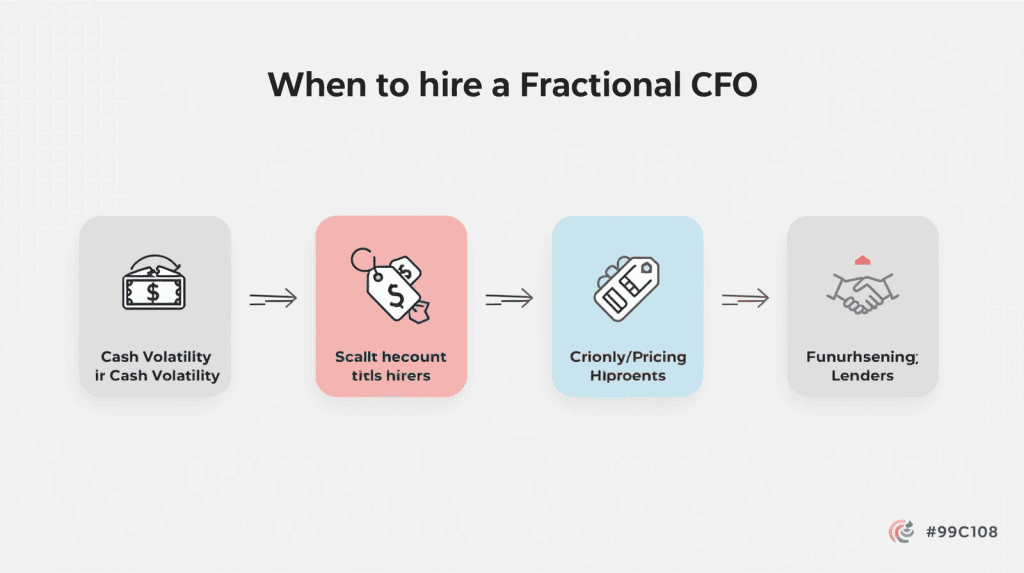
Cash-Flow Volatility, Fundraising Prep, Or Lender Requirements
Cash has a way of turning “we’ll figure it out” into “we need answers by Friday.” Clear signals include:
- You’re experiencing cash-flow volatility (seasonality, project-based revenue, unpredictable collections).
- You’re prepping for fundraising and need investor-ready numbers, a compelling story, and clean assumptions.
- A lender asks for monthly reporting, covenant tracking, or a forward-looking model, and you’re scrambling.
- You’re relying on a line of credit but don’t have a consistent process to forecast borrowing needs.
If your bank balance is the main dashboard, you’re driving by looking in the rearview mirror. A fractional CFO helps you see the road, especially the potholes.
Fractional CFO Vs. Full-Time CFO Vs. Finance Consultant
These roles can sound interchangeable. They’re not. The right choice depends on how much leadership you need, how complex the business is, and how often decisions require CFO-level input.
Differences In Accountability, Scope, And Decision Support
A simple comparison:
- Fractional CFO: Ongoing leadership and accountability, but part-time. You’re getting a partner who helps run the finance agenda, not just deliver a deck.
- Full-time CFO: Deep integration, constant availability, and ownership across finance, strategy, and often operations. Best when complexity and decision volume justify the cost.
- Finance consultant: Usually narrower scope and time-bound (e.g., “build a pricing model,” “support a transaction,” “fix forecasting”). Useful for specific projects, but often less embedded in your weekly decisions.
If you want someone to sit with you monthly (or weekly), call out tradeoffs, and help you choose a path, fractional CFO is closer to what you’re looking for.
Typical Engagement Models: Retainer, Project-Based, Interim Coverage
Most fractional CFO engagements land in one of these models:
- Retainer (most common): A set monthly fee for a defined cadence, weekly cash review, monthly reporting package, quarterly planning, ad hoc support.
- Project-based: A specific outcome with a timeline, fundraising model, lender package, KPI overhaul, finance function rebuild.
- Interim coverage: You need temporary CFO leadership during a transition (CFO departure, acquisition integration, ERP implementation).
Retainers work well when you need consistent decision support. Project work fits when the biggest value is creating a system or asset you’ll reuse.
How To Evaluate And Select The Right Fractional CFO
When you hire a fractional CFO, you’re not hiring a “numbers person.” You’re hiring judgment, communication, and the ability to build clarity out of messy reality.
Industry Fit, Stage Experience, And Financial Systems Fluency
Start with fit that actually matters:
- Stage experience: Someone who’s great in a $200M company may struggle in a 15-person team where processes are still forming. You want a CFO who’s been effective at your stage.
- Business model fit: SaaS, eCommerce, agencies, manufacturing, professional services, each has different cash cycles and KPI logic. Your fractional CFO should know what “good” looks like in your model.
- Systems fluency: They don’t need to be your admin, but they should be comfortable with your stack (common examples: QuickBooks or Xero, a billing system, payroll, and a BI/dashboard tool). If they can’t explain how close quality impacts forecasting quality, that’s a problem.
A strong signal: they ask smart questions about your revenue recognition, gross margin drivers, AR aging, and close timeline, before they talk about fancy models.
Interview Questions That Reveal Strategy, Communication, And Ownership
Skip abstract “what’s your leadership style?” questions and ask things that force specifics:
- “Walk me through how you’d set up a 13-week cash forecast for our business.”
- “Tell me about a time you found a margin problem. What did you change, and what was the result?”
- “How do you handle it when the books are late or unreliable?” (You want a builder, not a blame-thrower.)
- “What does your monthly reporting package include, and why?”
- “How do you want to work with the bookkeeper/controller and our CPA firm?”
- “What decisions do you expect me (the CEO) to make differently within 60 days?”
Listen for clear tradeoffs, not jargon. A good fractional CFO can translate finance into decisions your leadership team will actually use.
References, Case Studies, And Red Flags To Watch For
Do reference checks, even if you’re moving fast. Ask prior clients:
- Did they improve decision-making speed and confidence?
- Did forecasting get more accurate over time?
- Were they proactive, or did you have to pull everything out of them?
- How did they handle tough conversations?
Red flags worth taking seriously:
- They only talk about “reports” and never about decisions, tradeoffs, or outcomes.
- One-size-fits-all dashboards that ignore your economics.
- They avoid ownership language (“You could consider…”) but never recommend.
- They can’t explain concepts simply. Your team needs clarity, not mystery.
You’re looking for someone who can be confident without being theatrical, calm, direct, and consistent.
Costs, ROI, And Budgeting For A Fractional CFO
Pricing varies widely, and that’s normal, because the value varies widely. The key is to tie cost to the outcomes you need, not to an abstract hourly rate.
What Drives Pricing: Time, Scope, Cadence, And Complexity
Fractional CFO costs typically depend on:
- Time commitment: A few hours a week vs. multiple days a week
- Scope: Cash + reporting only, or full planning, fundraising, lender management, and team leadership
- Cadence: Weekly executive touchpoints cost more than monthly check-ins
- Complexity: Multiple entities, job costing, inventory, multi-currency, complicated revenue recognition
In practice, many companies budget a monthly retainer that aligns to a predictable rhythm (weekly cash + monthly close + quarterly planning). Project work is often priced around a defined deliverable and timeline.
How To Estimate ROI: Cash Runway, Margin Gains, Better Decisions
ROI is real, but it often shows up in a few specific places:
- More cash runway: Better collections, smarter payment timing, tighter inventory or WIP management. Extending runway by even 4–8 weeks can prevent desperate decisions.
- Margin gains: Fixing discounting discipline, renegotiating vendor terms, adjusting pricing, or identifying unprofitable work. A 1–3 point gross margin improvement can be meaningful fast.
- Better decisions (fewer expensive mistakes): Hiring at the right time, cutting the right costs (not random costs), choosing the right financing, avoiding covenant surprises.
A practical way to evaluate it: ask, “If this fractional CFO helps me avoid one major mistake this year, or makes one major decision cleaner, what is that worth?” In many businesses, it’s more than the retainer.
Setting Up The Engagement For Fast Wins
The fastest way to waste a fractional CFO is to keep the engagement vague. “Help with finance” sounds nice, but it doesn’t create momentum.
Define Outcomes, Metrics, And Decision Rights Up Front
Before week one, align on:
- Your top 3 outcomes (e.g., “stabilize cash forecasting,” “improve gross margin visibility,” “prepare lender package by May”)
- Success metrics (forecast accuracy, close timeline, runway confidence, KPI adoption)
- Decision rights (who approves hiring, pricing changes, budget variances)
This prevents the common trap where finance produces analysis, but nobody knows who’s supposed to decide, and then nothing changes.
Data And Tool Readiness: Accounting Close, Chart Of Accounts, Dashboards
Fractional CFO work sits on top of your data foundation. If the foundation is shaky, your first “win” might be boring but crucial:
- A consistent monthly close checklist (and a close calendar your team can actually hit)
- A cleaned-up chart of accounts that matches how you manage the business
- Clear definitions for KPIs (so Sales, Ops, and Finance aren’t using different math)
You don’t need a perfect tech stack. You do need consistent inputs. A slick dashboard fed by messy books is just a prettier argument waiting to happen.
Operating Rhythm: Weekly Cash Review, Monthly Close, Quarterly Planning
Most companies see traction when a fractional CFO installs a predictable cadence:
- Weekly: cash review (AR priorities, upcoming payments, runway, line-of-credit usage)
- Monthly: close + financial review (P&L, balance sheet, cash flow, KPI pack)
- Quarterly: planning (targets, capacity, headcount, scenario updates)
This rhythm is what turns finance into an operating system, not a monthly surprise.
Working With Your Team And External Partners
A fractional CFO is at their best when they’re amplifying your team, not replacing it.

Hand-Offs With Bookkeepers, Controllers, CPA Firms, And Payroll
Clean hand-offs prevent duplicated work and dropped balls. Clarify who owns:
- Transaction coding and reconciliations (bookkeeper)
- Close review, accruals, financial statement integrity (controller, if you have one)
- Tax planning and filings (CPA)
- Payroll processing and compliance (payroll provider / HR)
- Forecasting, KPIs, strategic analysis, executive reporting (fractional CFO)
If your fractional CFO is constantly redoing bookkeeping, either the upstream process needs fixing, or you hired the wrong level of support.
Aligning Leadership: CEO, Ops, Sales, And Department Budgets
Finance only works when it’s cross-functional. Expect your fractional CFO to spend real time with:
- Sales: pipeline realism, CAC/payback (if relevant), discounting discipline, quota capacity
- Ops/Delivery: utilization, throughput, inventory/WIP, staffing models, cost drivers
- Department leads: budgets that connect to controllable drivers (not just last year + 10%)
And yes, this can be uncomfortable at first. But the point isn’t to “police” departments, it’s to connect plans to numbers so you can make tradeoffs early, when you still have options.
Conclusion
If you’re considering whether to hire a fractional CFO, the real question is: are your next decisions big enough that you can’t afford fuzzy numbers?
A good fractional CFO gives you more than reports. You get a cash and planning cadence, sharper visibility into margins and drivers, and someone who can look you in the eye and say, “Here’s what I’d do, and here’s the risk if you don’t.”
Pick one who understands your stage, communicates without hiding behind jargon, and is willing to own outcomes with you. Then set clear goals, fix the data basics, and commit to a rhythm. That’s when fractional CFO support stops being an expense and starts acting like infrastructure.
What does it mean to hire a fractional CFO?
To hire a fractional CFO means bringing in CFO-level finance leadership on a part-time or flexible basis. Instead of doing day-to-day bookkeeping, they focus on planning, cash strategy, forecasting, KPI reporting, and decision support—so you get senior judgment without the full-time CFO cost.
When should I hire a fractional CFO for my business?
Hire a fractional CFO when finance blind spots start getting expensive—like cash-flow volatility, margin pressure, late or unreliable closes, or hiring ahead of revenue. It’s also common when you’re preparing for fundraising, responding to lender reporting requirements, or scaling into new products, locations, or markets.
How is a fractional CFO different from a full-time CFO or a finance consultant?
A fractional CFO provides ongoing accountability and decision support, but part-time. A full-time CFO is deeply embedded and available constantly, typically justified by higher complexity and decision volume. A finance consultant is usually project-based and narrower in scope (e.g., a pricing model), not a recurring leadership partner.
What deliverables should I expect when I hire a fractional CFO?
Common deliverables include a 13-week cash forecast, a 6–18 month financial model, cash runway strategy, KPI dashboards tied to real operating drivers, margin and unit-economics analysis, and board/investor reporting. You should also expect a cadence—weekly cash reviews, monthly reporting, and quarterly planning.
How much does it cost to hire a fractional CFO, and what drives pricing?
Fractional CFO cost is usually based on time commitment, scope (cash/reporting vs. fundraising and lender management), meeting cadence, and business complexity (inventory, multi-entity, revenue recognition, etc.). Many companies use a monthly retainer for a predictable rhythm, while projects are priced per deliverable and timeline.
How do I find and vet the right fractional CFO before I hire one?
Prioritize stage and business-model fit (SaaS, eCommerce, services, manufacturing), plus systems fluency (e.g., QuickBooks/Xero and dashboards). Ask specific interview questions about cash forecasting, margin fixes, and how they handle messy books. Check references for proactivity, clarity, and measurable decision-making improvements.