

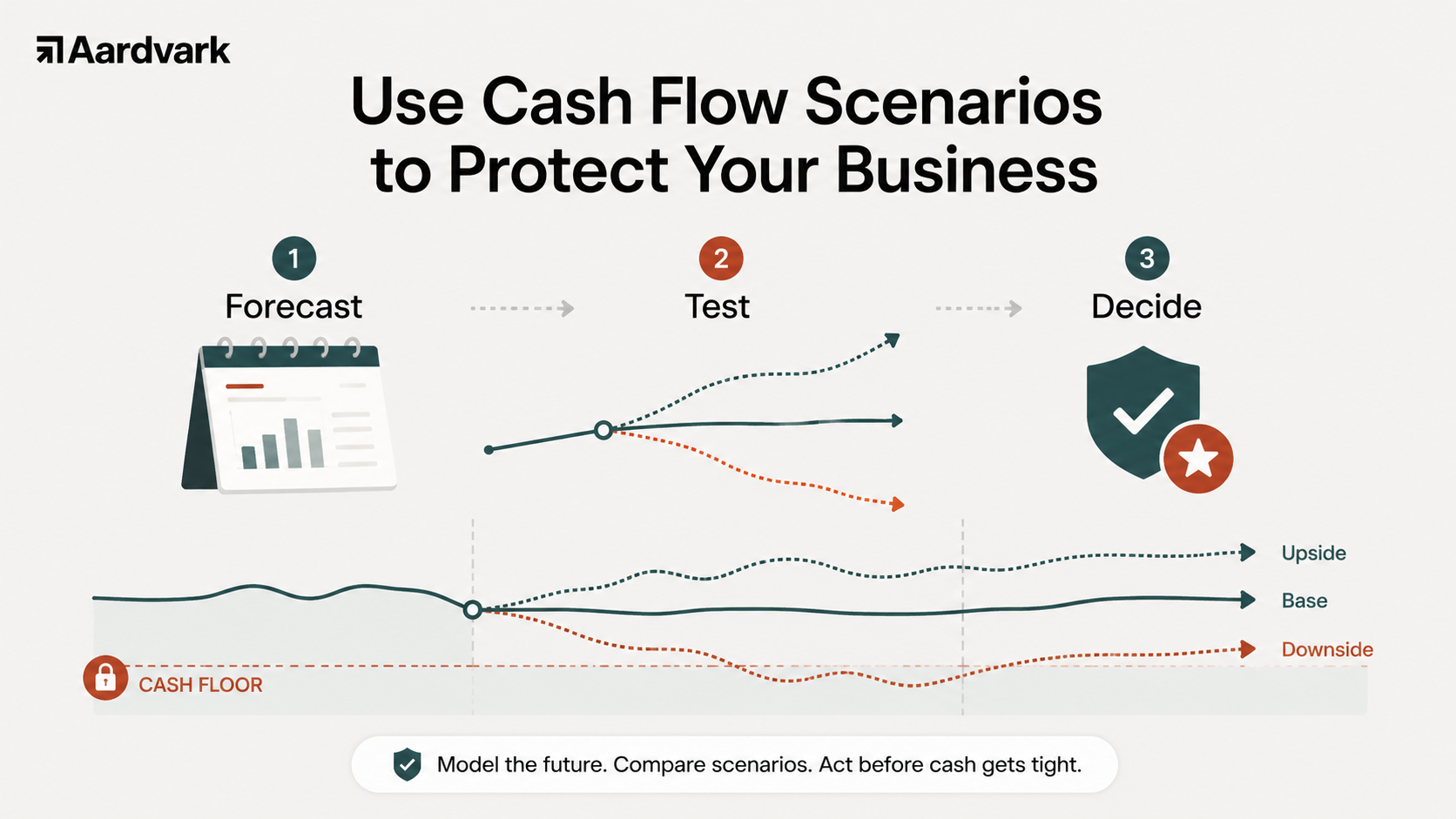
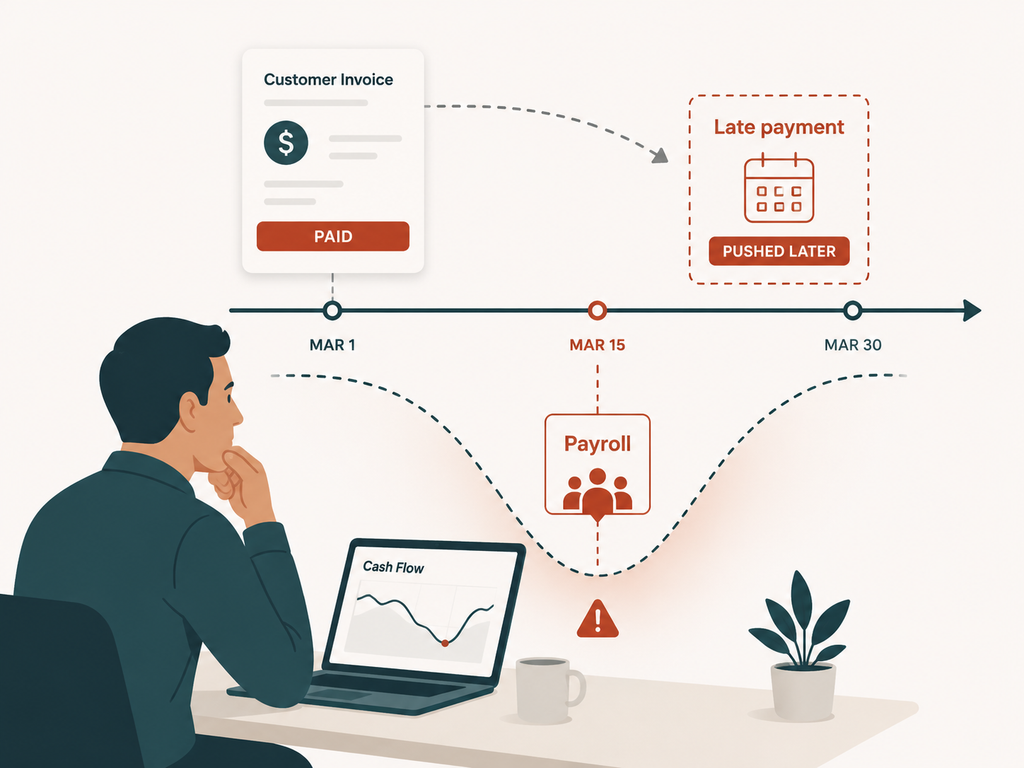
A profitable business can still run short of cash at exactly the wrong time. A customer pays three weeks late. Payroll lands before a large invoice clears. A new hire starts producing revenue more slowly than expected. None of these events necessarily mean the business is unhealthy, but they can create serious pressure when you have not planned for the timing.
Cash flow scenario planning for small business turns those unknowns into questions you can test before making a commitment. Instead of relying on one forecast and hoping reality follows it, you build several reasonable versions of the future and see what each one does to your cash balance.
This guide shows you how to build useful cash flow scenarios, choose assumptions that matter, interpret the results, and turn the analysis into better operating decisions.
Key takeaways
- Start with a realistic base forecast before creating alternative scenarios.
- Test changes in timing as well as changes in revenue and expenses.
- Model a small number of decisions that could materially affect cash instead of changing every assumption at once.
- Track the lowest projected cash balance, not just total revenue or profit.
- Compare forecasts with actual results regularly so your assumptions improve.
- Use scenario planning before hiring, purchasing equipment, expanding, increasing owner distributions, or taking on significant new commitments.
What cash flow scenario planning actually tells you
A cash flow forecast estimates the money expected to enter and leave your business over a defined period. Scenario planning builds on that forecast by asking what happens when important assumptions change.
The distinction matters because a normal forecast gives you one expected path. Financial scenario analysis gives you several possible paths.
A simple model might contain:
- Base case: What you currently expect to happen.
- Downside case: What happens if collections slow, sales fall, or costs rise.
- Upside case: What happens if demand increases or collections improve.
The goal is not to predict exactly which version will occur. Forecasts are estimates by definition. The FDIC’s Money Smart cash flow guidance encourages small business owners to make reasonable assumptions and revise projections as conditions change.

Scenario planning adds a decision layer to that process. It helps answer questions such as:
- Can we afford to hire in September instead of January?
- What happens if our largest customer pays 30 days later than usual?
- Can we purchase equipment without drawing on our line of credit?
- How much cash do we need before opening another location?
- What happens if sales grow but collections do not improve?
- How long can we operate if revenue drops for two months?
These questions make scenario planning more useful than simply watching your bank balance.
Why profit does not answer the same question
Profitability and liquidity measure different things.
A business can record revenue when a sale is earned while receiving the cash weeks later. At the same time, payroll, rent, subcontractors, debt payments, taxes, and suppliers may need to be paid immediately.
The FDIC notes that a profit and loss statement can mask cash shortages under accrual accounting, while cash flow projections help businesses see whether expected receipts will cover expected payments. Its small business financial management materials also identify equipment purchases, seasonal inventory, financing needs, and sales goals as practical reasons to prepare projections.
That timing difference is why a company can look successful on its income statement but still face a cash squeeze.
If unpredictable balances are already affecting payroll, vendors, or purchasing decisions, it may be useful to first understand the operational causes of a business cash crunch before adding more complexity to your forecast.
How to build cash flow scenarios step by step
Useful cash flow scenario planning for small business does not require dozens of tabs or complicated formulas. A basic spreadsheet can work if the assumptions are visible, the timing is realistic, and the model is updated frequently.
A 13-week rolling forecast is particularly useful for operational decisions because it provides enough time to spot problems while keeping the assumptions close enough to current conditions to remain practical. For longer-term decisions such as expansion, major capital spending, or annual hiring plans, you can add a six- or 12-month view.
Step 1: Build your base cash flow forecast
Start with the version of the future you consider most likely.
List expected cash inflows by week or month, including:
- Customer collections
- Cash sales
- Recurring revenue
- Financing proceeds that have already been committed
- Other predictable cash receipts
Then list expected outflows:
- Payroll and payroll taxes
- Rent
- Vendor and subcontractor payments
- Debt service
- Software and recurring subscriptions
- Insurance
- Taxes
- Inventory
- Capital purchases
- Owner distributions
- Other scheduled obligations
Your model should calculate beginning cash, total inflows, total outflows, net movement, and ending cash for each period.
For owners who need a stronger forecasting framework, a dedicated cash flow forecasting process can connect receivables, payables, operating patterns, and planned business decisions instead of treating the forecast as a static spreadsheet.
Step 2: Separate assumptions from known amounts
Do not treat every number in the forecast as equally certain.
A signed lease payment next month has much higher certainty than revenue from a proposal that has not been accepted. Payroll may be predictable to the dollar, while customer collections depend on invoice timing and payment behavior.
Create an assumptions section that identifies variables such as:
| Assumption | Base case | Downside case | Upside case |
| Monthly sales | $120,000 | $100,000 | $135,000 |
| Average collection delay | 35 days | 50 days | 28 days |
| Monthly payroll | $48,000 | $48,000 | $54,000 |
| Gross margin | 42% | 36% | 45% |
| Equipment purchase | Month 4 | Month 4 | Month 3 |
This structure makes the model easier to audit because you can see why each scenario changes.
Step 3: Choose variables that actually affect cash
One common mistake in what-if analysis for cash flow is changing too many assumptions at once.
If sales, pricing, payroll, collections, margins, overhead, and capital spending all change simultaneously, you may see the outcome but not understand which variable caused it.
Start with the few factors that create the greatest exposure.
For a service company, those might be accounts receivable timing, payroll, utilization, and customer concentration.
For a retailer, inventory purchases, seasonal demand, supplier terms, and gross margin may matter more.
For a project-based business, deposit schedules, milestone billing, labor timing, and subcontractor payments can dominate the cash picture.
Step 4: Create a downside case that is uncomfortable but plausible
A downside scenario should not assume disaster simply to produce a frightening chart.
It should represent conditions that could reasonably occur.
For example:
- Sales fall 15% for eight weeks.
- Your largest customer pays 30 days late.
- Material costs increase 8%.
- A planned contract starts six weeks later.
- Payroll increases before the new hire becomes productive.
The useful question is not, “What happens if everything goes wrong?”
It is, “What combination of believable setbacks would create a cash problem, and how early could we see it?”
Step 5: Add an upside case without assuming all growth is good cash flow
Growth can increase cash pressure.
Suppose a company wins $80,000 of new monthly work. That sounds positive. But if it must add staff immediately while customers pay on 45-day terms, the company could spend significant cash before receiving the first payment.
Your upside scenario should therefore account for the working capital required to support growth, not simply add revenue.
The U.S. Small Business Administration recommends prospective financial projections when planning a business and specifically includes projected cash flow statements as part of that financial outlook. Its guidance also suggests greater detail in earlier projection periods, such as monthly or quarterly estimates. See the SBA’s business planning guidance on financial projections.
Step 6: Identify the cash floor in every scenario
Do not judge a scenario only by the ending balance.
A business might begin with $200,000, fall to $18,000 in week eight, and recover to $170,000 by week 13. Looking only at the final figure hides the period of greatest risk.
For each scenario, track:
- Lowest projected cash balance
- Date of the lowest balance
- Number of weeks below your desired minimum
- Maximum financing required
- Time required to recover
- Specific assumption that creates the decline
This is often where the most valuable information appears.
Step 7: Compare forecasted results with actual results
Scenario planning gets better when you learn which assumptions are consistently wrong.
At the end of each week or month, compare forecast versus actual results. Look at differences in collections, sales, payroll, vendor payments, and discretionary spending.
Do not simply overwrite the old forecast. Record the variance first.
If customers consistently pay nine days later than your assumption, that is useful operational data. If sales are accurate but margins miss every month, your pricing or cost assumptions may need work.
The scenarios small businesses should test first
You do not need 20 scenarios. Four or five well-chosen cases can expose most short-term cash risks.
A major customer pays late
Customer payment timing is one of the easiest risks to underestimate.
Imagine a business expects a $75,000 customer payment in week six. Payroll of $52,000 falls in week seven. The base forecast appears comfortable because the invoice arrives first.
Now move that payment from week six to week nine.
Nothing changes about the company’s revenue or profit. Yet its available cash could change dramatically.
That is why financial scenario analysis should model collection timing, not only sales.
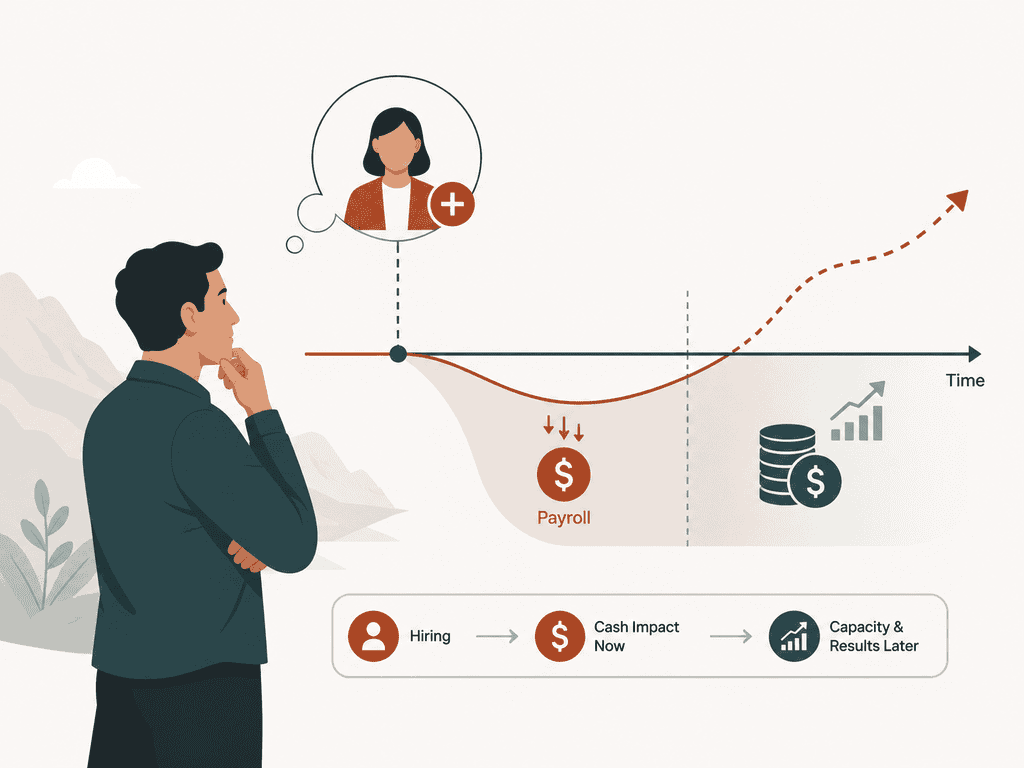
Hiring one or more employees earlier
A new employee affects more than salary.
Your forecast may need to account for recruiting fees, payroll taxes, benefits, equipment, software licenses, training time, and the delay before the employee contributes revenue or capacity.
Suppose a business has $180,000 in cash and wants to hire two employees at a combined monthly cash cost of $18,000.
The base case may support hiring immediately. But a scenario combining the hires with slower collections could show the company’s cash floor falling below its minimum reserve within nine weeks.
The decision may not become “do not hire.” It might become “hire one person now and the second after two customer milestones clear.”
That is exactly the type of decision scenario planning should improve.
Losing or delaying a major contract
If a small number of customers generate a meaningful share of revenue, model what happens when one disappears or renews later than expected.
Do not remove only the revenue. Also adjust the costs associated with serving that customer.
Some costs disappear when revenue disappears. Others remain.
That distinction helps determine whether the true cash impact is severe, manageable, or smaller than the headline revenue loss suggests.
Making a large purchase
Equipment, inventory, renovations, vehicles, and technology investments can create a temporary cash trough even when the purchase makes financial sense over several years.
Compare at least three possibilities:
- Pay cash now.
- Delay the purchase.
- Finance part of the cost.
A proper model should include repayment schedules and interest rather than assuming financing has no cash cost.
The SBA’s small business financial management guidance recommends using financial information to account for costs and evaluate business decisions.
Setting aside money for taxes
A strong operating month does not mean every dollar in the bank is available to spend.
Depending on your business structure and tax situation, you may need cash for estimated tax, payroll tax, sales tax, or other obligations.
The IRS explains that many self-employed taxpayers and businesses may need to make estimated payments during the year. Current requirements depend on entity type and individual circumstances, so tax assumptions should be confirmed with a qualified tax professional or the IRS estimated tax guidance.
Your scenario model should show tax payments in the periods when cash actually leaves the business.
How to turn scenario results into business decisions
A spreadsheet has little value if it never changes what you do.
The best use of scenario planning is to identify decision thresholds before the business reaches them.
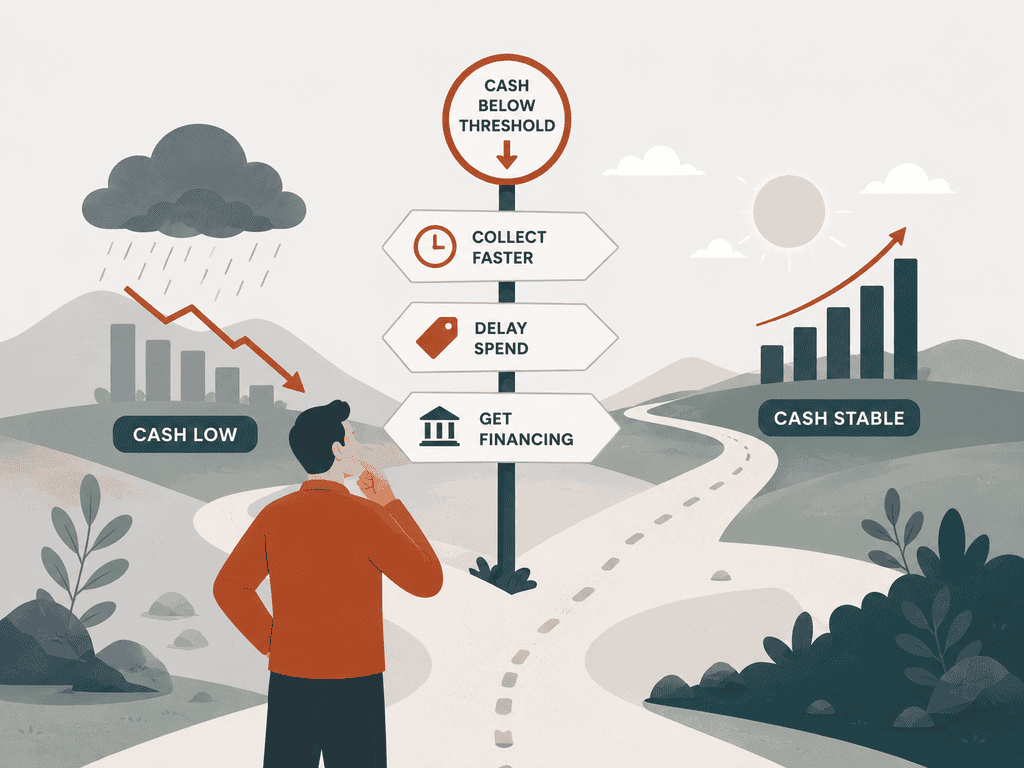
Suppose your downside case shows cash dropping below your minimum acceptable balance in week ten. You then have several possible actions:
- Collect a deposit before beginning new projects.
- Tighten collection follow-up on overdue invoices.
- Negotiate longer supplier terms.
- Delay a discretionary purchase.
- Move a hiring date.
- Arrange financing before cash becomes tight.
- Change the timing of owner distributions.
This creates an operating plan rather than a financial warning.
Use trigger points instead of vague concern
Define measurable triggers in advance.
For example:
If projected cash falls below $100,000 within eight weeks, freeze discretionary capital purchases until the forecast returns above the threshold.
Or:
If accounts receivable over 45 days exceeds $150,000, move collections review from monthly to weekly.
Triggers remove some emotion from financial decisions. You do not have to decide from scratch every time conditions change.
Connect operating actions to financial outcomes
Scenario planning works best when the person managing the model understands operations, not just accounting.
A bookkeeper may accurately record that payroll increased. Scenario analysis asks whether the increase was planned, when the additional capacity should begin producing revenue, and what happens if that revenue is delayed.
If financial responsibilities are spread across a bookkeeper, CPA, owner, and managers without anyone owning the forward-looking view, a more coordinated financial management structure can make forecasting and decision-making more useful.
This distinction is important. Historical reporting explains what happened. Scenario planning helps decide what to do next.
Common mistakes that make scenario planning unreliable
A technically correct spreadsheet can still create poor decisions.
Treating the base case as a promise
Your base case is an assumption, not a commitment from reality.
If the model says you will have $240,000 in 13 weeks, do not automatically treat that entire amount as spendable cash. Ask how sensitive the number is to collections, sales timing, margins, and other assumptions.
Changing only revenue
Revenue is rarely the only variable.
Higher sales can require more labor, inventory, commissions, subcontractors, shipping, or working capital. Lower sales may reduce some variable costs but leave fixed expenses untouched.
Model the operational consequences of the revenue change.
Using monthly periods when timing is tight
Monthly forecasting can hide problems.
Imagine $80,000 comes in on the 30th, but payroll of $55,000 goes out on the 15th. A monthly model may show enough total cash for the period while missing the mid-month shortage.
When liquidity is tight, weekly modeling provides more useful visibility.
Building scenarios once and never updating them
Conditions change.
A customer pays. A proposal falls through. A purchase gets delayed. A hire accepts earlier than expected.
Your forecast should incorporate new information rather than remaining frozen as a record of assumptions made three months ago.
Confusing precision with accuracy
A spreadsheet can calculate cash to the cent and still be wrong.
The quality of the output depends on the quality of the assumptions. A carefully formatted model based on unrealistic payment dates provides false confidence.
Spend more time questioning assumptions than formatting cells.
Ignoring the decision that comes after the forecast
“What if cash goes negative?” is only half the question.
The second half is, “What would we do about it, and how early would we need to act?”
For every meaningful downside scenario, identify at least one realistic response. If the response requires bank financing, customer negotiation, staffing changes, or cost reductions, estimate how much lead time the action requires.
Build decisions around cash, not guesses
Cash flow scenario planning does not remove uncertainty. It makes uncertainty easier to manage.
A useful model shows where cash could become tight, which assumptions create the pressure, and how much time you have to respond. That gives you something far more valuable than a prediction: a set of options before the decision becomes urgent.
For financial, tax, lending, or investment decisions that could materially affect your business, use scenario planning as a decision-support tool and confirm the final decision with the appropriate qualified professional.
FAQs
What is cash flow scenario planning for small business?
Cash flow scenario planning for small business is the process of testing how different assumptions affect future cash balances. It usually starts with a base forecast and adds alternative scenarios for changes such as lower sales, delayed customer payments, higher expenses, or new hiring.
How is scenario planning different from cash flow forecasting?
A cash flow forecast shows one expected path for future inflows, outflows, and cash balances. Scenario planning tests several possible versions of that path so you can see how particular events or decisions could change liquidity.
How far ahead should a small business forecast cash flow?
A 13-week weekly forecast is useful for short-term operating decisions because it covers roughly one quarter without relying heavily on distant assumptions. Businesses considering expansion, seasonal planning, or major investments may also use six- or 12-month projections alongside the shorter forecast.
What scenarios should a small business model?
Start with events that would materially change cash, such as delayed receivables, lower sales, hiring, major purchases, margin pressure, customer loss, or tax payments. Choose scenarios that are plausible and connected to decisions you may actually need to make.
How often should cash flow scenarios be updated?
Update the underlying forecast whenever material information changes and compare actual results with the forecast regularly. Many businesses benefit from weekly forecast updates and deeper monthly reviews, although the right frequency depends on transaction volume and how tight cash is.
Can I do what-if analysis for cash flow in Excel?
Yes. A spreadsheet can be enough for many small businesses if inputs are organized clearly and assumptions can be changed without rewriting the entire model. More complex businesses may benefit from accounting integrations, forecasting software, or professional financial support.
When should I get professional help with cash flow planning?
Consider professional guidance when you are making decisions that could significantly affect liquidity, such as expansion, debt financing, restructuring, major hiring, or a business sale. A financial professional can also help when forecasts repeatedly miss actual performance or when accounting data is too fragmented to support reliable assumptions.