

A profitable business can still run into trouble if cash shows up late, bills hit early, or one slow-paying client throws off the month. That’s why cash flow forecasting matters so much. It gives you a forward-looking view of what’s likely to happen to your cash position, not just a backward-looking report of what already happened.
For small businesses, cash flow forecasting is less about building a perfect model and more about making better decisions sooner. When you can estimate future cash, track actual cash inflows and outflows, and spot tight weeks before they happen, you get room to act. You can push collections, adjust payment timing, pause spending, or rethink hiring before a cash crunch forces your hand.
Key Takeaways
- Cash flow forecasting is the process of estimating future cash inflows and outflows over a set forecast period.
- A good cash flow forecast helps you protect liquidity, manage working capital, and make informed decisions.
- The best forecasts are updated often and compared against actual cash movement.
- Short-term cash flow forecasting is usually most useful for day-to-day control.
- Your forecast should reflect timing, not just totals. That’s where many businesses go wrong.
What cash flow forecasting actually tells you
Cash flow forecasting is the process of estimating how much cash will come into the business, how much will go out, and what your ending cash balance is likely to be over a given time horizon. That sounds simple, but it gives you something most financial statements don’t: a practical view of cash available when you need it. A P&L can show strong net income while your bank balance stays tight because revenue, invoice timing, inventory, payroll, loan payments, and vendor terms all move on different schedules.
That’s why a cash flow forecast is such a useful tool for managing a small business. It helps you see future cash flow, not just current results. You get visibility into short-term cash needs, likely pressure points, and how changes in accounts receivable, accounts payable, or working capital can impact cash flow before the impact hits your account.

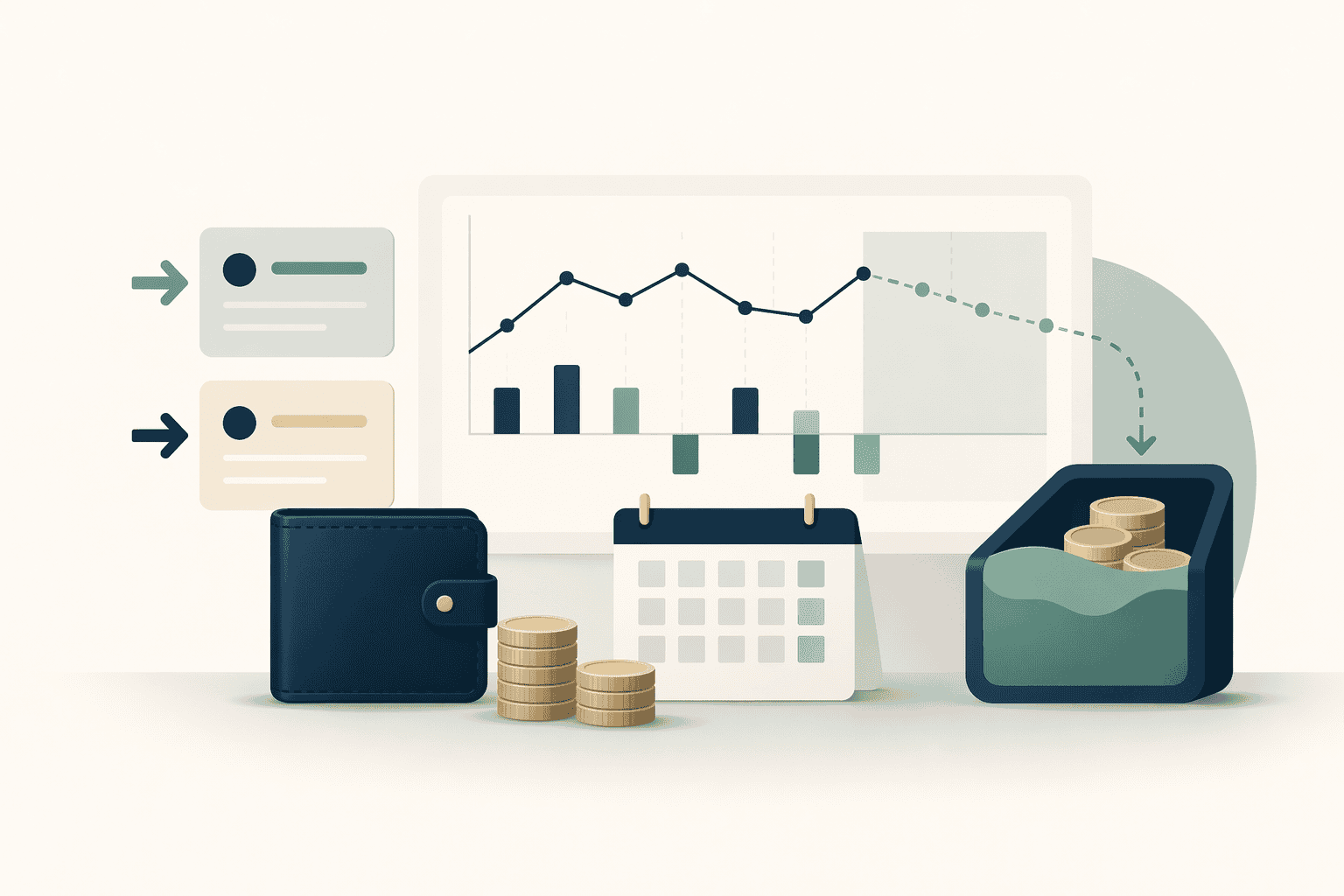
If you want a clear visual in WordPress, this is the place to pair the article with a simple process graphic showing three layers: cash receipts, cash payments, and ending cash balance over a 13-week window.
A few related concepts matter here. The U.S. Small Business Administration recommends using financial statements and cash flow projections to manage business finances and plan ahead, especially when building monthly or quarterly projections for the first year of planning. Working capital also plays a direct role in short-term liquidity because it reflects the gap between current assets and current liabilities. For many owners, that gap is where cash issues start to show up.
When cash feels unpredictable, it often helps to connect forecasting with broader financial visibility, not just bookkeeping. And if collections, payment timing, or runway are already under pressure, the practical fixes usually look a lot like the steps used to solve a cash crunch. For a broader finance function, cash planning also fits naturally within virtual CFO services. On the planning side, the SBA’s guide to managing your finances and its advice on writing business plans with monthly or quarterly projections are useful benchmarks for how structured a forecast should be.
How to build a cash flow forecast that’s useful
Creating a cash flow forecast does not have to start with complex forecasting tools. A spreadsheet is enough if the structure is right and the data is maintained. What matters most is choosing the right forecast period and level of detail. For most small businesses, a 13-week cash flow forecast works well for short-term cash flow management because it matches real operating decisions. A monthly version can sit on top of that for a longer-term projection.
Start with opening cash on hand. Then list expected inflows and outflows by week or month. Your cash inflows and outflows should reflect actual cash movement, not accounting timing. That means customer payments when they are expected to land, not when the invoice is sent. It means payroll when it clears, vendor payments when you expect to pay them, debt service when due, tax payments on the actual due date, and capital expenditures in the period cash leaves the bank. The closer your forecast matches actual cash behavior, the more useful it becomes.
Step 1: Forecast cash coming in
Begin with future cash inflows. Look at open invoices, customer payment habits, subscription renewals, scheduled deposits, and any expected loan proceeds or owner contributions. This is where accounts receivable deserves extra attention. If a client is technically due in 30 days but historically pays in 47, your accurate cash flow forecast should reflect 47, not 30.
This is also why manual data can cause trouble. A forecast built from wishful due dates instead of real payment patterns will overstate liquidity. If your business has seasonality, break inflows down by week and use historical cash receipts, not just sales numbers. A forecast is an estimate, but it should be grounded in behavior.
Step 2: Forecast cash going out
Now map cash outflows. Include payroll, rent, software, debt payments, taxes, contractor costs, inventory, utilities, insurance, and any large one-off items. Don’t forget accounts payable timing. Stretching payables by a week might improve immediate cash, but it can create vendor strain or service interruptions later.
This is where many businesses underestimate the cash impact of normal operations. Small recurring payments stack up. So do annual renewals, quarterly tax payments, and irregular purchases. A good best practice is to separate fixed cash outflows from variable ones so you can quickly see what’s committed and what’s adjustable if cash gets tight.
Step 3: Calculate net cash and ending balance
Once projected cash inflows and projected cash outflows are listed, calculate net cash flow for each period:
Net cash flow = total cash inflows – total cash outflows
Then update the ending cash balance:
Ending cash balance = opening cash balance + net cash flow
This sounds basic, but it’s where the forecast becomes a decision tool. You can see how much cash is likely to be available, whether your cash position is improving or weakening, and where a gap is likely to appear. If you want an accompanying visual, a simple table showing opening balance, cash receipts, cash payments, net cash flow, and ending balance makes the concept easy to scan.

Direct vs indirect forecasting
Most small businesses benefit from direct forecasting for short-term use because it tracks actual cash inflows and outflows by date. It’s practical, easy to explain, and closest to how owners operate. Indirect forecasting starts with net income and adjusts for non-cash items like depreciation and amortization, plus changes in working capital. That method is useful for longer-range financial planning, but it’s less helpful when you need to know whether payroll clears next Friday.
If you’re trying to forecast cash flow for the next 30 to 90 days, direct forecasting is usually the better fit. If you’re building annual models, lender materials, or board reporting, the indirect method can add value alongside the direct view. The right forecasting approach depends on the question you need the forecast to answer.
Businesses that outgrow a basic spreadsheet often need more than software. They need a tighter cash flow forecasting process tied to operations, plus stronger oversight from a fractional CFO group if planning has become too important to run ad hoc. For practical frameworks, SCORE’s cash flow statement template is useful for structuring projections, and HubSpot’s overview of financial forecasting is a decent refresher on how forecasting supports broader financial planning.
A simple cash flow forecast example
Imagine a small agency starts the month with $60,000 in cash on hand. It expects $45,000 in cash receipts from clients, but based on payment patterns, only $38,000 is likely to arrive this month. It also expects $42,000 in cash payments, including payroll, contractors, software, rent, taxes, and debt service. That leaves net cash flow of -$4,000, and an ending cash balance of $56,000.
At first glance, that may not look serious. But now add one delayed customer payment of $12,000 and a software annual renewal of $6,000 that was not in the first draft. Suddenly net cash flow is -$22,000, and the ending cash balance drops to $38,000. That may still be positive, but if the business usually keeps a $35,000 floor for payroll and fixed costs, liquidity is effectively gone. That’s the value of forecasting. It shows the pressure before it becomes urgent.
A more complete cash flow forecast example would separate weekly line items so you can spot when the problem occurs. A monthly total can hide a week where payroll hits before collections. A weekly model makes the actual cash movements visible. It also helps you test scenarios: What if you speed up collections by seven days? What if a vendor deposit moves to next month? What if you defer a hire by 30 days? These are small operational changes with real cash impact.
Forecasting methods become even more useful when you compare them to actuals. If you projected $38,000 of cash coming in and only $29,000 arrived, the lesson is not that forecasting failed. The lesson is that your assumptions need work. Maybe customer payment behavior changed. Maybe one large invoice was disputed. Maybe the sales team counted a deal that had not yet become an invoice. Every miss improves the next forecast if you review it honestly.
That review process also helps with profitability. If revenue looks fine but cash is weak, the issue may be collections, margin leakage, bloated overhead, or poor timing between inflows and outflows. That’s often when cash planning overlaps with solving profitability problems despite revenue growth. To sharpen that analysis, many finance teams also watch working capital drivers like receivables and payables; Investopedia’s working capital explainer and its overview of how changes in working capital affect cash flow are useful references for the mechanics.
Common mistakes that weaken a forecast
The first big mistake is confusing profit with cash. A sale on the P&L does not improve liquidity until the money arrives. The same goes for expenses. You may record an expense this month but pay the bill later. That difference between accounting activity and cash movements is exactly why cash flow forecasting helps businesses use data in a more practical way.
The second mistake is using the wrong level of detail. Too little detail and the forecast becomes vague. Too much detail and nobody maintains it. A good rule is to be detailed where timing or amount meaningfully changes the cash position. Payroll, rent, taxes, debt service, large customer receipts, inventory buys, and big one-off expenses usually deserve their own lines. Tiny recurring charges can be grouped.
Another common issue is treating the forecast as a one-time exercise. A full cash flow forecast should be updated on a routine cadence, often weekly for short-term cash and monthly for longer-term planning. If you don’t compare projected cash to actual cash inflows and outflows, the model will drift away from reality. Forecasting is not a static document. It’s an operating rhythm.
Some businesses also rely too much on manual data and too little on process. They wait until the owner feels anxious, then build a rushed spreadsheet from bank balances and memory. That usually misses payment timing, tax obligations, and non-cash items that affect the indirect method. It also leaves no clean audit trail for why assumptions changed. If you can automate feeds from accounting systems and standardize the forecasting process, you improve accuracy and save time.
Finally, many owners ignore scenario planning. A forecast that shows only one version of the future is useful, but not enough. Good forecasting methods include a base case, downside case, and stretch case. That gives leadership a clearer view of cash flow needs under different conditions and supports more informed decisions around hiring, financing, pricing, and spending. For small teams, even three simple scenarios can improve strategic planning dramatically. HubSpot’s piece on AI and cash flow forecasting is helpful if you’re exploring ways to automate data handling and reduce spreadsheet friction without losing judgment.
How to make cash flow forecasting part of decision-making
A forecast is most valuable when it changes what you do. If you see a short-term cash dip six weeks out, you have options. You can accelerate invoice follow-up, negotiate deposits, tighten payment terms, delay discretionary spend, or line up short-term financing before you urgently need it. That’s far better than checking the bank account every morning and reacting after the problem lands.
Cash flow forecasting also improves strategic decisions. You can test whether the business can support a new hire, equipment purchase, expansion, pricing shift, or marketing push. Instead of asking, “Can we afford this eventually?” you ask, “What happens to cash available in the next 13 weeks and the next six months if we do this now?” That is a much better question.
For most organizations, the rhythm is straightforward. Update the short-term cash forecast weekly. Review the longer-range projection monthly. Compare forecast vs actual cash movement. Adjust assumptions about customer payment timing, vendor behavior, payroll changes, tax obligations, and sales conversion. Keep ownership clear. Someone should be responsible for maintaining the model, and someone should be responsible for acting on what it shows.
When the process is working, you get a much clearer view of cash. You know your minimum cash floor. You know when net cash flow is tightening. You know whether changes in working capital are helping or hurting. You stop making strategic decisions with partial information. And you start using forecasting as a practical tool for managing financial health, not just a report for lenders or board decks.
What is cash flow forecasting in simple terms?
Cash flow forecasting is a way to estimate how much cash will come into and leave your business over a future period. It helps you understand whether you’ll have enough cash available to cover payroll, vendor payments, taxes, and other obligations.
How far out should a small business forecast cash flow?
For most small businesses, a 13-week forecast is the most useful short-term view because it helps with weekly operating decisions. Many businesses also keep a monthly forecast that extends 6 to 12 months for planning, budgeting, and larger strategic decisions.
What is the difference between a cash flow forecast and a budget?
A budget usually focuses on planned revenue and expenses over a period, often by month or year. A cash flow forecast focuses on timing, showing when cash actually comes in and goes out, which is why it is more helpful for managing liquidity.
Can I build a cash flow forecast in a spreadsheet?
Yes. A spreadsheet is often the best place to start because it makes the forecasting process visible and easy to adjust. The key is to keep it grounded in actual cash inflows and outflows, update it regularly, and compare it to real results.
How often should I update my cash flow forecast?
If cash is tight or the business is changing quickly, update it weekly. Even in a more stable business, monthly updates are usually the minimum if you want an accurate cash flow forecast that remains useful for decision-making.
What makes a cash flow forecast accurate?
Accuracy comes from realistic timing, not optimistic assumptions. Use real customer payment patterns, known due dates, seasonal trends, and frequent forecast-to-actual reviews to improve the model over time.
Should I use the direct method or indirect method?
For short-term cash flow forecasting, the direct method is usually better because it tracks expected cash receipts and cash payments directly. The indirect method is more useful for longer-term financial planning because it starts with net income and adjusts for non-cash items and changes in working capital.